


















+Anniversay+Dinner.jpg)









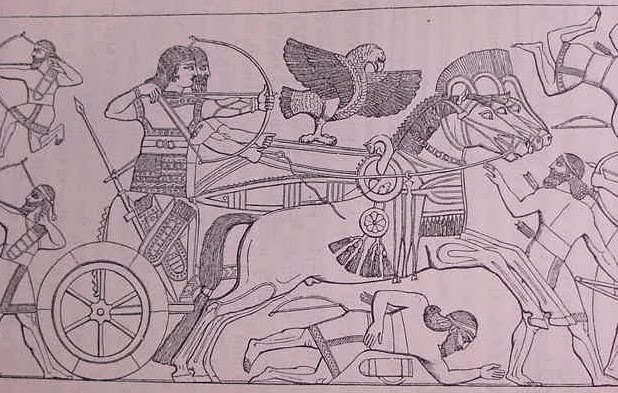




When persecution of the Christians was undertaken by Diocletian (303-311), it was because he wanted to establish a church-state in the worship of the sun-god (Baal).
"The moon, from the angle of the esoteric knower, is simply an obstruction in space, an undesirable form which must some day disappear." - Alice Bailey
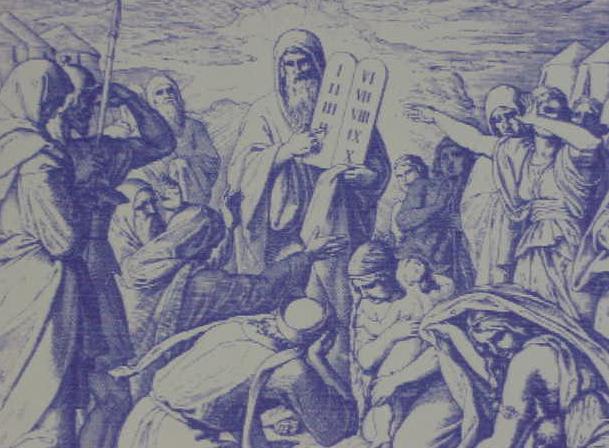
The first commandment the Jews were given as a people is the mitzvah of Rosh Chodesh, the New Moon: “And God said to Moses...in the land of Egypt ... This month is for you, the head of the months. First it is for you among the months of the year.” - Ex 12:1-2
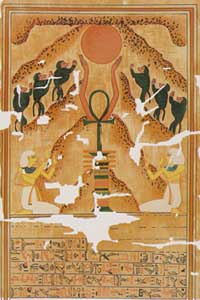
This is a strange first commandment. You'd think the development of the calendar would only come after the establishment of the basic fundamentals like the Ten Commandments. And yet the Torah considers the process of establishing the new month as a major breakthrough in creating a nation. And what was wrong with the solar calendar that everyone else had been using? What is the significance of basing the Jewish calendar on the moon? First of all, by focussing the attention of the people on the moon, Moses hoped to expungle from their mmory the the astrological lore of the Egyptian solar religion as expressed in the famous hymn of pharaoh Akhenaten in which we find verses that are anticipating Darwin's image of the “little, worm pond.”
You who bring children into being in women,
and make fluid into mankind,
Who nourishes the son in the womb of his mother,
and soothes him that he weeps not,
O Nurse in the womb!
Who gives breath in order to keep alive
all that he has made;
When he comes forth from the womb on the day of
his birth,
You open his mouth in speech, and give all that
he needs.
According to Aquinas, the active part of the semen (the animal spirit) remains until the generative process is completed. This part also obtains heat from the sun, confirming the claim of Aristotle, that “man is generated by man and the sun.” Coperncius pictures the sun in his book (Revol. I,10) as All Seeing Being, visible god and mentions the stars as his “family” according to the classical definition of the sun as Father of All.http://www.oneyearbibleblog.com/2008/04/april-1st-on
How wise was the pharaoh Akhenaten, the hero of the modern heliocentric science? Consider the passage of his famous Hymn to Aten: “Thy rays, they embrace the lands to the limits of all thou hast made.” Really? Take a look how far the sunrays reach during a solar eclipse! Not far really. Only a small corona is visible.
We find an amazing parallelism between Akhenaten’s and Constantine’s religious worldviews. In Plutarch’s “Isis and Osiris” we find a story that Akhenaten in his childhood had a dream: a god resembling the sun god Ra took him by his hand and from an exceedingly high mountain showed him all the kingdoms of the world and then said to him: All these things will I give to you, if you restore my rule. And Akhenaten, in a bloody revolution, did restore the rule of the sun god (heliocentrism). He built for his new god and for himself a new capital Akhetaton (presently known as El Amarna) and proclaimed the new divine rule Aton worshiped by the Germanic tribes under the name of Wotan.
The concept of the flat earth mentioned 420 times in the Quran's 6200+verses and suggested by Mt 4:8 story about Jesus being tempted by devil on a exceedingly high mountain from which all kingdoms of the world could be seen was embraced by a early Church father Lactantius who rejected the spherical shape of the earth.
Lactantius’s Divinae institutions (Divine precepts) published in Lyons in 1541 include a chapter titled De antipodes, ridiculing the notion of a round earth: “Can there be anyone so inept to believe that men exist whose extremities lie above their heads…that trees can grow downwards, and that rain, and snow , and hail go upwards instead of falling to earth?” Lactantius, taught Crispus, Constantine's son that the earth was flat like a cake and surrounded by heaven filled with fire and water. Crispus was killed by his father.
www.zazzle.co.uk/yggdrasil_tree_of_life_poste.. www.answers.com/topic/world-tree
Moses rejected this dogma of the Egyptian solar religion because he knew of the precious fruits put forth by the sun and moon (Dt.33:14). The precious things put forth by the moon refers to those plants that depend on moonlight, as many plants do. Making all life dependent on solar energy as the solar religions do betrays a deep ignorance of the processes proceeding in nature. Take for example vernalization.
Many temperate plants have a vernalization requirement and must experience a period of low winter temperature to initiate or accelerate the flowering process, or, as the case with many fruit tree species, to actually break dormancy, prior to flowering. Many plant species, including some ecotypes of Arabidopsis thaliana and winter cereals such as wheat, must go through a prolonged period of cold before flowering occurs. This ensures that reproductive development and seed production occurs at the optimum environmentally favorable time, normally following the passing of winter. The needed cold is often expressed in chill hours. (Wiki)
Moses Rejected Racism of the Aryan Solar Religion
And here is a teaching about the sun from Hindu cosmology expressing its immobility and the creative power, The real substance of the concealed (Sun) is a nucleus of Mother substance. It is the heart and the matrix of all the living and existing Forces in our solar universe. It is the Kernel from which proceed to spread on their cyclic journeys all the Powers that set in action the atoms in their functional duties, and the focus within which they again meet in their Seventh Essence every eleventh year. He who tells thee he has seen the sun, laugh at him as if he had said that the sun moves really onward on his diurnal path . . .
“When we speak of ’Light Bodies’ we are referring the consciousness of the central sun that existed before the beginning outside of time and space. In many cultures the Sun has been revered as a god. The Sun is not just a burning form of gas as our scientists would have us believe, it is a portal of initiation to the intelligence of the Great Central Sun of even Greater Central Suns.” (Hugh Fitzroy Colmer The Celestial Man of Light. Eph 5:8)
Let me remind here that Aldous Huxley told T. Leary that the obstacle to the evolution was the Bible: “Drugs that open the mind to multiple realities inevitably lead to a polytheistic view of the universe. We sensed that the time for a new humanist religion based on intelligence, good-natured pluralism and scientific paganism had arrived.” Indeed, it had arrived along with N. Copernicus.
The same heliocentric, racist teaching echoes in an official prayer of Avalokiteshvara, who emanated from the right eye of his spiritual father Amitabha (Spiritual Sun) is described as a puer aeternus (cp. Baby Jesus): “Generated from ten million rays his body is completely white (the favoured race of the Romans). His head is adorned and his locks reach down to his breast”.
Even now, the average Brahminic (The Sanskrit term Brahma means 'energy', the solar energy) psyche treats the cow as sacred, but not the buffalo. Why does the buffalo remain a non-sacred and most invisible animal? Why did it not get constitutional protection as the cow did? Simply because the cow belongs to the white race in the animal kingdom and the buffalo belongs to the black race. This is an Indian variety of racism.
All white races constructed their color (the color of the sun god) as superior, the Indian Aryans also made the color sacred. The color black in general and dark people, buffaloes and other animals, irrespective of their utility or beauty were/are condemned both in social and spiritual realms (Kancha Ilaiah, Caste and the UN meet – The Hindu. Online edition of India's National Newspaper, Tuesday, August 21, 2001)
In more remote times, products now known to be poisonous were used to whiten the skin. For example, as early as 400 B.C.E. The Greeks whitened their skin with a face powder of lead carbonate. Poppea Sabin, the wife of Roman Emperor Nero, used this toxic substance to whiten her face. In the 16th c., arsenic was used by some Italian women to give their faces a translucent appearance.
Relativity of Light
Creatures like us who see only in visible light deduce that everyone in the entire Universe, including God, must see in visible light. The difference between black and white is not a matter of color, but of how much light they reflect. The terms are relative, not absolute. Black and white are fundamentally the same thing; the difference is only in the relative amounts of light reflected, not in their color. The fraction of incident light that human skin reflects varies widely from individual to individual. Skin pigmentation is produced mainly by an organic molecule called melanin, which the body manufactures from tyrosine, an amino acid common in proteins. Albinos suffer from a hereditary disease in which melanin is not made. Their skin and hair are milky white. The irises of their eyes are pink. Albino animals are rare in nature because their skins provide little protection against solar radiation, and because they lack protective camouflage. Albinos tend not to last long.
There is a particular organic pigment responsible for the absorption of light in such flowers as roses and violets – flowers so strikingly colored that they’re named after their hues. It’s called anthocyanin. Remarkably, a typical anthocyanin is red when placed in acid, blue in alkali, and violet in water. Thus, roses are red because they contain anthocyanin and are slightly acidic; violets are blue because they contain anthocyanin and are slightly alkaline. Blue pigments are hard to come by in nature. The rarity of blue rocks or blue sands on earth is an illustration. Only the heavens radiate blue and declare the Glory of God.
Whereas the sun is the symbol of unchanging nature, rising in the east, setting in the west, day in and day out every day of the year, the moon changes and it seems to be telling us something. And her message thwarts all matematical calculations. The moon is mathematically unpredictable. By commandment of the New Moon which meant the rejection of Egyptian mathematical and godless science Moses consolidated his nation.
Jews calculated the month according to the phases of the moon, each month consisting of either twenty nine or thirty days, and beginning with the appearance of the new moon. It was impossible to know in advance whether a particular month would have twenty-nine or thirty days. The length of the moon was never determined until the thirtieth day actually arrived.
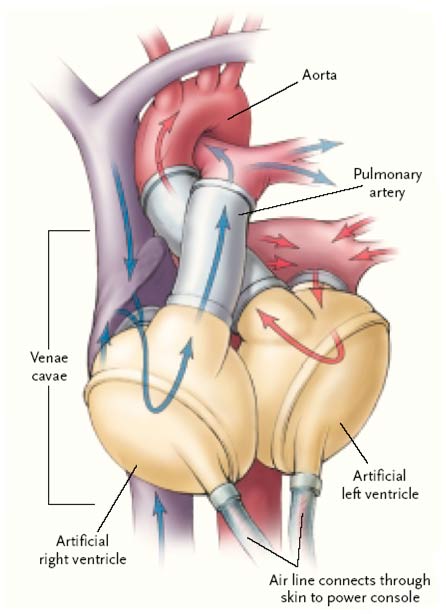
When the Sages of Israel decided to adopt the Calculated Rabbinical Calendar to avoid further tragic political persecutions the Moon of that calendar became a mean or average moon moving uniformly, in the same way as the artificial moon of Hilarius (or Dr. Jarvik's artificial heart), which is used in the Julian and Gregorian Calendars. The beginning and duration of the months depend on the moladoth (the times of the new moon) and the time which elapses from one molad to the next. The average figure given by tradition for this interval is 29 days and 12 hours and 793 parts.
This mathematical hoax was invented by the ancient Egyptian astrologers who used the time when the old crescent was invisible in the morning as the beginning of their month. This Egyptian custom of using the old crescent was embraced by our modern astronomers who also use the conjunction as the marker. And that also explains why the Torah considers the process of establishing the new month as a major breakthrough in creating a nation. The Jewish national uniqueness is reflected in their calendar which became the catechism of this nation. There is no room for flawed mathematical formula in Science of the Hebrew Bible. The Hebrew prophets did not express their teachings in the imaginary mathematical equations. The Biblical Calendar is the science of synchronicity between the heavens and the earth.
Only God can expose heliocentrists' pretentious ignorance and He actually did that to prove the Truth of His teaching. “Owing to inequalities in the rate of both the solar and the lunar motion in longitude, the mean conjuntion (molad) may precede or be preceded by the true conjunction.” (Cecil Roth, editor, Enc. Judaica, Vol.5, p. 46, article: Calendar.)
Moses Thrashes 'Big Bang'
The Vedic god Surya was a solar bull. According to the Assyrians, the bull was born of the sun. So, Moses took the calf, which they had made, and burnt it with fire, and ground it to powder, and scattered it upon the water, and made the people of Israel drink it. (Ex. 32:20). Then Moses said to Aaron, “What did this people do unto thee, that you hast brought a great sin upon them?”
Moses posed a direct question to the high priest, who led the people astray in their wickedness. It is written: thou shall not follow a multitude to do evil (Ex. 23:2). Here, Aaron has immediately done exactly that. Note Aaron’s response:
“And Aaron said, 'Let not the anger of my lord burn hot; you know the people, that they are set on evil. 23 For they said to me, `Make us gods, who shall go before us; as for this Moses, the man who brought us up out of the land of Egypt, we do not know what has become of him.' 24 And I said to them, `Let any who have gold take it off'; so they gave it to me, and I threw it into the fire, and there came out this calf." (RSV Exodus 32:22-24 22) Why gold? Well, Egypt was rich in gold, which was valued for its beauty and because it was believed to be of the flesh of the sun god. So this calf came out of the fire exactly like Daniel's Bar Elahin came out of the fiery furnace, because m=E/c². Apollo was called Eleleus because he orbited in a collected mass of fire. The first principle alternately creates the world from itself and again itself from the world, and all things, Heraclitus says, are an exchange for fire, and fire for all things, as goods are for gold and gold for goods.” (Plutarch, On the E at Delphi 388DE). Christianity regards Daniel as a saint and as prophet. Judaism considers the Book of Daniel a part of its canon, but does not regard Daniel as a prophet.
Evolving Bull
In later Jewish folklore the Biblical story was supplemented with remark that the “calf was walking by itself and grazing in the pasture.” (See, Pirqei deRabbi Eliezer 25: “Satan entered it and mooed in order to misled Israel.”).. As a result of its relentless evolution the golden calf mutated to a Moses of the British Israelites, aka John Bull wearing Union Jack with the Babylonian solar cross on his chest.
Encyclopedia Britannica calls Moses “This former stammering murderer”* because he dared to kill a sadistic slave master thus preventing a senseless murder of a helpless human being. But can a slave be considered a human being in the context of Malthus's Essay on Population?
*The Elizabethan poor laws of the 1580s treated the able-bodied poor as prisoners in workhouses and gave the rest starvation-level aid (the royal welfare, or the royal euthanasia). The labor market meant that the costs and restraints that serfdom imposed on the lord could be rudely jettisoned. Now the landlord could just hire workers in exchange for cash. As the villagers grew older and less capable of hard labor, the lord would not renew their contracts and would turn them loose on the highways, and into the town and forests. The towns restricted immigration. In the forests, if the peasants were not too old they could join groups, such as the one headed by Robin.
Nimrod Conquers the Hebrew University
Babylonian culture displays a systematic assault on Biblical government. Modern science is only the capstone of a long philosophical maturation that includes evolutionists and heliocentrists from the Babylonian “mighty hunter before the Lord, Nimrod, Pharaohs to Roman emperors-gods to Hitler who tried to replace God's Law with Aryan myths. From Genesis throughg the Prophets (e.g., Micah 5:6) to Revelation, Nimrod's Babylon is associated with seduction, and the boldest element of political seduction seems to be economic. If Babylon is the great political organizer of men and merchants, it is the Canaanites who are the slaves of the slaves (Gen 9:25); not living for themselves (to say nothing of God) but existing as worker-drones, fulfilling the lusts created by Babylon. And Roman empire was a copy of Babylon in every respect. The Roman did not accumulate their wealth by working hard; they stole the wealth of other nations by turning them into slaves after their conquest.
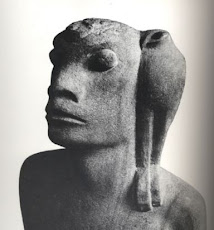
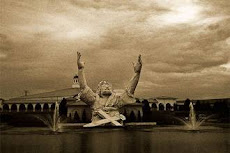
In 1938-1939 sculptor Yitzhak Danziger created his statue “Nimrod”. The unveiling of the statue caused a scandal. The Hebrew University of Jerusalem which commissioned Danziger's statue was not happy with the result and religious circles made strong protests.
The Nimrod Statue was also taken up as the emblem of a cultural-political movement known as “The Canaanites”* which advocated the shrugging off the Jewish religious tradition, cutting off relations with Diaspora Jews and their culture, and adopt in its place a “Hebrew Identity” based on ancient Semitic heroic myths – such as Nimrod's. Though never gaining mass support, the movement had a considerable influence on Israeli intellectuals in the 1940 and early 1950s (http://en.wikipedia.org/wiki/Nimrod_(king).
*Olympian Zeus was equated, in local terms, with the Syrian and Phoenician (Canaanite) Baal Shamin, already worshipped by the Syrian troops in Jerusalem. Throughout the entire history of Israel there had existed a conflict between Yahwist belief and the nature worship of the Canaanites. Now, Hellenistic suzerains were actually identifying Yahweh with Baal. (See, below)
The New Agers anticipate the return of Horus as the reincarnation of Nimrod who will at last unite mankind in a victorious rebellion against God. (Gen. 10 and 11). The Gilgamesh Epic describes the first "God is dead" movement. (J. Lennon's song Imagine is their mantra)
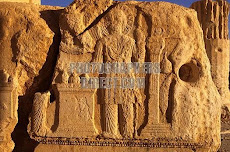
It is from one of the Sun temples in Palmyra, Syria, namely from the temple of Bel (Baal), that the great image of Bel was removed and taken to Rome, where it was erected. This was done by emperor Aurelian of Rome, who was known as “the sun-emperor”. Aurelian also took the image of Helios, another Sun-deity, from Palmyra, and erected it in Rome. So, the worship of Bel, the founder of Babylon, eventually became established in Rome. No wonder that the Church Father Augustine candidly wrote that “Rome was funded as the second Babylon and as the daughter of the former Babylon.”
The Chair of St Peter in the Vatican was claimed to be a holy relic, but in 1968 it was exposed by a scientific commission as being no older than the 9th century More significantly, according to the Catholic Encyclopaedia, is that it is decorated by twelve plates portraying the twelve labours of Hercules. This same work claims that Hercules was another name for Nimrod before becoming a deity of the Greeks
The classic depiction of the Devil also has Draco-like horns. Nimrod was given the title Baal (the Lord) and Semiramis was Baalti (My Lady). The Latin term for my lady is Mea Domina which in its corrupted Italian form became Madonna. Nimrod was represented in a dual role of God the Father and Ninus, the son of Semiramis
The father of Nimrod in the text of Genesis was Cush, also known as Bel or Belus. Nimrod was the fish-god Dagon who was depicted as half man, half fish. It is possible that this was symbolic of him being half human, half scaled reptile.
The Canaanites in Action: Baal over YHWH
Hebrew University Prof wants Academic Freedom to be
Denied to God and Moses
Tel Aviv University – Ran HaCohen's (Dept of Comparative Literature)
continues to serve as Hamas' Mouthpiece
Dr. Rantisi, Hamas's dead leader used to argue that Allah - many times wrongly translated as 'God' - is not the God of the Bible, nor the God of Abraham, Isaac and Jacob. Allah is another deity, one who drinks blood as water, who loves jihad and terror, and promises virgins in his so-called paradise to those who kill Jews - the more the better. Accordingly, we learn from a Palestinian post stamp that the true god of Palestine is Baal-Zephon who was a principal mighty one of Ugarit or Ras Shamra, and of the Canaanite people who lived in that area of Syria. Israel was given a choice; they could follow Yahweh to their permanent freedom in the Promised land or they could return to enslavement in Egypt with its idol worship, wherein the idolatry of Baal-Zephon was popular.
Baal was originally, it appears, associated with specific places and sanctuaries; in Ugarit temple he is equated with Dagon. Baal was also known as the sun idol, Baal-Hannan. He had received the name Hannan, or the “grace”. That is exactly what the Pauline Christians teach, that the manner of spiritual life is all grace. “The law has been done away with the Christ’s death; now, do anything you please” is the teaching of Pauline churchianity.
(A. Hislop in his Two Babylons wrote: “From the historian Castor (in Armenian translation of Eusebius, pars. I, p. 81) we learn that it was under Bel, or Belus, that is Baal, that the Cyclops lived; and the Scholiast on Æschylus [chapter II, section II, sub-section I, note 22] states that these Cyclops were the brethren of Kronos, who was also Bel or Bal, as we have elsewhere seen [chapter II, section II, sub-section I]. The eye in their forehead shows that originally this name was a name of the great god, for that eye in India and Greece is found the characteristic of the supreme divinity. The Cyclops, then, had been representatives of that God—in other words, priests, and priests of Bel or Bal. Now, we find that the Cyclops were well-known as cannibals, Referre ritus Cyclopum, "to bring back the rites of the Cyclops," meaning to revive the practice of eating human flesh. (Ovid, Metam., XV, 93, Vol. II, p. 132. The term cannibal is derived from Cahna-Baal, priest of Baal. Pagan Rome of old offered human sacrifices to Baal on these crosses.”
Human sacrifice was fundamental to the religion of Babylon and wherever the Babylonian Brotherhood and their reptilian bloodlines have traveled, human sacrifice has always gone with them because the “reptilians” demand these rituals. The malevolent ones seem to be addicted to blood and this has been passed on to their crossbreeds.The Babylonian priests were required to eat some of their sacrificial offerings and so the word for priest, Cahna-Bal, became the term for eating human flesh, cannibal. Moloch, the name of that flying lizard was another name for Nimrod-Tammuz.
Excavations in Ashkelon, Ekron, and Gath reveal dog and pig bones which show signs of having been butchered, implying that these animals were part of Philistines' diet. Philistines were identified by KJV as Palestinians.
There is no doubt about it that it was A. Hitler himself who inspired Dr. Rantisi to identify the god of Palestinians with the pagan Canaanaite sun god Baal (Bull). The Nazi leader said once about his Palestinian ally Mufti Haj Amin al Hussein: “ He
Tuesday, August 31, 2010

Wednesday, August 25, 2010
Science and Denying Israel's Legitimacy
Hebrew University Prof wants Academic Freedom to be Denied to God and Moses
When Malcolm Hoenlein made his acceptance speech after receiving the Guardian of Zion Award from Bar-Ilan University’s Ingeborg Rennert Center for Jerusalem Studies in Jerusalem last month, he quoted Rashi’s opening to his commentary on the Bible. Hoenlein, the longtime executive vice chairman of the Conference of Presidents of Major American Jewish Organizations, wasn’t engaging in talmudic casuistry, however. What he was doing was making an impassioned defense of Israel’s legitimacy and its historic connection and right to the land, and in particular to Jerusalem.
Answering the question, put in the name of Rabbi Isaac, as to why the Torah does not begin with the first mitzva, Rashi replies that the Torah begins with an account of the Creation so that if there ever comes a time when the nations of the world accuse the Jewish people of having stolen the Land of Israel, the Jews can respond: “The entire world was created by and belongs to God. He created it and He granted it to whomever He deemed fit.” For Hoenlein, that time has come.
Current attempts to deny the Jewish claim to the Land of Israel, and in particular to deny the Jewish claim to Jerusalem, bear out the wisdom of that commentary, says Hoenlein. “The dismissal of the biblical account by people who supposedly believe in the Bible and say they took the Bible and added to it, I think underscores the hypocrisy of the position, but also reveals their true intent,” he declares.
From Y. Danziger to B. Obama
Babylonian culture displays a systematic assault on Biblical government. Modern science is only the capstone of a long philosophical maturation that includes evolutionists and heliocentrists from the Babylonian “mighty hunter before the Lord, Nimrod, Pharaohs to Roman emperors-gods to Hitler who tried to replace God's Law with Aryan myths. From Genesis throughg the Prophets (e.g., Micah 5:6) to Revelation, Nimrod's Babylon is associated with seduction, and the boldest element of political seduction seems to be economic. If Babylon is the great political organizer of men and merchants, it is the Canaanites who are the slaves of the slaves (Gen 9:25); not living for themselves (to say nothing of God) but existing as worker-drones, fulfilling the lusts created by Babylon. And Roman empire was a copy of Babylon in every respect. The Roman did not accumulate their wealth by working hard; they stole the wealth of other nations by turning them into slaves after their conquest.
Copernicus's Virgil-inspired work suggests tht the Bible has nothing to do with divine revelation, or that the God revealed to the first parents and especially in the history of Israel is a liar. The founding fathers of modern astronomy, using the words of the Pslamist:
“They set their mouth against the heavens, and their tongue walketh through the earth.”
“And they say, how doth God know” And “Is there knowledge in the Eternal God?” (Ps 73: 9-11)
In 1938-1939 sculptor Yitzhak Danziger created his statue “Nimrod”. The unveiling of the statue caused a scandal. The Hebrew University of Jerusalem which commissioned Danziger's statue was not happy with the result and religious circles made strong protests.
The Nimrod Statue was also taken up as the emblem of a cultural-political movement known as “The Canaanites” which advocated the shrugging off the Jewish religious tradition, cutting off relations with Diaspora Jews and their culture, and adopt in its place a “Hebrew Identity” based on ancient Semitic heroic myths – such as Nimrod's. Though never gaining mass support, the movement had a considerable influence on Israeli intellectuals in the 1940 and early 1950s (http://en.wikipedia.org/wiki/Nimrod_(king).
The Holocaust of the Polish, mostly religious Jews was not a bad news among these circles (See below).In 1938-1939 sculptor Yitzhak Danziger created his statue “Nimrod”. The unveiling of the statue caused a scandal. The Hebrew University of Jerusalem which commissioned Danziger's statue was not happy with the result and religious circles made strong protests.
The Nimrod Statue was also taken up as the emblem of a cultural-political movement known as “The Canaanites” which advocated the shrugging off the Jewish religious tradition, cutting off relations with Diaspora Jews and their culture, and adopt in its place a “Hebrew Identity” based on ancient Semitic heroic myths – such as Nimrod's. Though never gaining mass support, the movement had a considerable influence on Israeli intellectuals in the 1940 and early 1950s (http://en.wikipedia.org/wiki/Nimrod_(king). The Holocaust of the Polish Jews was not a bad news among these circles.
In the middle of the war, the British government sent Freya Stark (During World War II, she joined the Ministry of Information and contributed to the creation of a propaganda network aimed at persuading Arabs to support the Allies or at least remain neutral) , a pro-Arab archaeologist and author, on extensive lecture tour of the U.S. Her mission was to build American support for British policies, especially for those regarding Palestine. In other words, her mission was to logjam and undermine Polish emissary Karski's mission seeking political help of the Allies in in rescuing Jews from the exterminating policy of the Nazis. Miss Stark, a non-Jew, was impressed by the amount of anti-Semitism she ran across among well-to-do, well-educated Americans. Her activities were foreshadowed by a Nazi propaganda film Erbkrank.
A. Bailey's goal is not “reorganization of world religions”, that Goal calls for:
“the gradual dissolution – again if in any way possible – of the Orthodox Jewish faith, with its obsolete teaching, its separative emphasis.”
Bailey consistently, in the spirit of the British maniacal anti-Semitism – denied everything negative in the world as “Jewish” then called for the total destruction of Judaism – and even hints at the destruction of the Jews themselves as well. She saw nothing wrong with the Holocaust – it was just that “old “Jewish karma” coming back at last.
Bailey's Apostles or the Enemy Within
Philosopher M. Polanyi observed, “Newtonian physics and Darwin’s notion of the survival of the fittest were key elements both in the Marxist concepts of class warfare and of racial philosophies which shaped Hitlerism and scientific world view.”
And we focus attention and concern on the Jewish Holocaust because
somehow we all have the feeling that it might just happen again.
Tel Aviv University - Daniel Breslau (Dept. of Sociology) gives “advice” to President Obama on how to manipulate Israel for Palestinian Benefit
Tel Aviv University – Ran HaCohen's (Dept of Comparative Literature) continues to serve as Hamas' Mouthpiece
Tel Aviv University - Chaim Gans (School of Law) thinks Israel has a right to exist only if it destroys all the settlements and withdraws to the Green Line. That is his "defence" of Zionism!
Tel Aviv University Marxist sociologist Yehuda Shenhav explains why the "Palestinian refugees" deserve compassion, but the Jewish refugees from Arab countries (or what he calls "Arab Jews") do not:
Award-winning blogger Doug Ross reports that a reliable source has provided an eyewitness account of what he saw on the videotape of the Rashid Khalidi farewell bash that the LA Times is suppressing. The eyewitness source, who Ross calls "a person who has provided useful, accurate and unique data from LA before" writes:
Saw a clip from the tape. Reason we can't release it is because statements Obama said to rile audience up during toast. He congratulates Khalidi for his work saying "Israel has no God-given right to occupy Palestine" plus there's been "genocide against the Palestinian people by Israelis."
The Universal Religion in the Space Age will be nonsectarian because its founding principle is pantheism:”If we move on to other planets, we may find that planetary religion must give way to solar religion – ONE FAITH for the solar system, and this in turn implies the ultimate need for a cosmic religion. We seem to be approaching universal citizenship, which implies the need for a universal religion.” Well, emperor Septimus Severus proposed to bring all his subjects together under the worship of Sol Invictus – the Unconquered Sun – and to subsume under that worship all the various religions and philosophies then current. All gods were to be accepted, as long as one acknowledged the Sun. Will the people who use the lunar calendar be exterminated?
The Myth of Our Time
“Ex arte et facultate astrologica dudum antea et ad hucusque (1520) tempora eciam apud exteras remotissimasque nations nominitassima et honoratissima semper existit.”
This quotation was excerpted from the resolution of the faculty of the Cracow University appropriating funds for the position of astrologer, Matthew of Miechow. The decision was approved of by Bishp Tomicki, chancellor of the University. The University was Europewide famous for its astrological horoscopes and mathematics, which N. Copernicus was studying during a period of five years (in qua atrium liberalium scola floret, arte mathematica celebris – Eneas Silvius). It will be instructive to remind in this context that the term “Genesis” meaning, nativity, horoscope was given by the Greek translators to the first book of the Bible. Suetonius mentions that Vespasian was admonished by the mathematicians to take head of Metius Pomposianus, because he had an imperial genesis. For the same reason Herod wanted to kill infant Jesus; he also had an imperial genesis which, by chance, as Ch. Darwin would say, came true. Shortly before Copernicus came to Cracow an astral alphabet for genethliacal purposes (i.e. to calculate nativities) was published in that town. Its impact on the mind of the young Copernicus is clearly recognizable in one of the passages of his “revolutionary” book.
The most famous Queen of all witches of the British Empire Sybil Leek in her memoirs entitled My Life in Astrology described how credulous the modern luminaries of the space are: “Florida proved to be the means of adding yet another group of people to my astrological portfolio. I live some twenty miles from the famous Cape Kennedy, home of the US space program…Through the help of my old friend, Ann Fague, formerly of Connecticut but now working as social aide in the protocol office of General David Jones at Patrick Air Force Base, I began to meet many people working on the space program. Scientists, engineers, astronauts, and their families, all seemed to trek to the house on the river, and I was amazed at how interested everyone was in my kind of scientific astrology (In case you don’t know, scientific astrology is a bastard sister of Science). Then I was invited to give a talk about astrology at one of the monthly luncheons, and I understand I broke a record for attendance. More amazing still were the questions from the enthusiastic audience. Not that everyone was pro-astrology, but to a lecturer, an avid interest is much more satisfying than a mutual admiration society. Many ladies came to me afterward, saying they had questions to ask not for themselves, but about their families. After this talk, there was a never-ending stream of inquiries about astrology, many of them from men at the Cape whose names later became household words in the space program. Practically all the top brass at their base also had their horoscopes done, and many predictions on world events were solemnly taken to the base to be locked in one of the many safes where they could be checked at appropriate times…Reading any of the magazines and papers, the astronauts emerge either as rare, godlike creatures unable to relate to the rest of mankind, or as cardboard characters with little depths or dimension to them as people.”
In a lecture delivered by Mr. Hiram Corson, Professor of Anglo-Saxon Literature at the Cornell University, Ithaca, N. Y., before the alumni of St. John's College, Annapolis, in July, 1875, the lecturer thus deservedly rebukes science:
"There are things," he says, "which Science can never do, and which it is arrogant in attempting to do. There was a time when Religion and the Church went beyond their legitimate domain, and invaded and harried that of Science, and imposed a burdensome tribute upon the latter; but it would seem that their former relations to each other are undergoing an entire change, and Science has crossed its frontiers and is invading the domain of Religion and the Church, and instead of a Religious Papacy, we are in danger of being brought under a Scientific Papacy -- we are in fact already brought under such a Papacy; and as in the sixteenth century a protest was made, in the interests of intellectual freedom, against a religious and ecclesiastical despotism, so, in this nineteenth century, the spiritual and eternal interests of man demand that a protest should be made against a rapidly-developing scientific despotism, and that Scientists should not only keep within their legitimate domain of the phenomenal and the conditioned, but should reexamine their stock in trade, so that we may make sure how far the stock of bullion in the cellar -- on the faith of whose existence so much paper has been circulating -- is really the solid gold of Truth. If this is not done in science as well as in ordinary business, scientists are apt to put their capital at too high a figure, and accordingly carry on a dangerously-inflated business. Even since Prof. Tyndall delivered his Belfast Address, it has been shown, by the many replies it has elicited, that the capital of the Evolution-School of Philosophy to which he belongs, is not nearly so great as it was before vaguely supposed to be by many of the non-scientific but intelligent portion of the world. It is quite surprising to a non-scientific person to be made aware of the large purely hypothetical domain which surrounds that of established science, and of which scientists often boast, as a part of their settled and available conquests."
Allow Me:
I am the Lord that maketh all things, that stretched forth the heavens alone; that spreadeth the earth by myself. That frustrateth the tokens of the liars, and maketh diviners mad; that turneth wise man backward and maketh their knowledge foolish” - Is 44:24-25
A mantra of the heliocentric astronomy proclaims: “Halley working in Newton’s program, calculated on the basis of observing a brief stretch of a comet’s path that it would return in 72-years’ time; he calculated to the minute when it would be seen again at a well-defined point of the sky. 72 years later, Halley’s comet returned exactly as Halley predicted.” Did it really? Halley predicted the return of his comet in 1758, but, according to Chinese and European records, the comet returned in March of 1759. Then the Halley’s comet returned in 1910, or 3.5 years earlier than predicted.
Indeed, every return of this comet brought significant changes with it, for instance, in 1986, declining from all previous orbits, this comet appeared in the Southern Hemisphere. The confusion of the Soviet scientists is mirrored in an article published in the journal Astronomiya i Astrofizika (1989) whose authors argued that “the motions of Halley’s comet are chaotic” and that “the model of its motions is not determined!” In political terms it meant an earthquake. On Oct. 4, 1957 when the first sputnik was launched from the Soviet Union, the Soviet scientists assured that its speed and trajectory were calculated using Newton’s Laws, the same laws that Halley used to calculate the trajectory of his comet. The nauseating prostitution of Soviet scientists to the immoral aims of their state seems to be overcome.
A Shooting-Star to the Rescue
Andrew D. White in his book History of the Warfare of Science with Theology in Christendom wrote: “Seneca, had the scientific instinct and prophetic inspiration to declared that the time would come when comets would be found to move in accordance with natural law.” The “prophecy” of Seneca had not been forgotten. Obviously, Copernicus rejected the Biblical interpretation of comets as extraordinary sent by God. The thoughts of Newton in science and Bayle in philosophy were evidently tending to accomplish the “prophecy” of Seneca.
Pierre Bayle, in tearing down the pretended scriptural doctrine of comets, tore down much else: of all men in his time, no one has so thoroughly prepared the way for Voltaire. He declared: “Comets are bodies subject to the ordinary law of Nature, and not prodigies amenable to no law.”
Newton, in 1686, having taken the data furnished by the comet of 1680, demonstrated that comets are guided in their movements by the same principle that controls the planets in their orbits. Halley recognized the comet of 1682 a one which had already appeared at stated periods, and foretold its return in about 75 year; and the battle was fully won when Clairaut, seconded by Lalande and Mme. Lepaute, predicted distinctly the time when the comet would arrive at its perihelion, and the prediction was reportedly verified.
Seneca, Copernicus, Galileo, Cassini, Newton, Halley, and Clairaut had gained the victory. The natural law cometary concept means that we are part of a system (Copernicus's machina mundi) not requiring constant patching and arbitrary interference. Interestingly, Kepler disagreed; he insisted on a compromise formula that comets might be heavenly bodies moving in regular orbits, and even obedient to law, and yet be sent as “signs in the heavens.”
It was total war of Science on Jewish people and their Biblical Science. That's exactly the same what the Psalmist expressed in his words: “Come, let us cut them off from nationhood, that Israel's name not be remembered anymore!” (Psalms 83:5)
Seneca, Copernicus, Galileo, Cassini, Newton, Halley, and Clairaut “killed the God of the Bible with their science” and their disciples sacrificed million of Jews to Copernicus's sun god (Baal, Molech etc) in the ovens of Auschwitz and in other places.
Following my Message to the National Ego
By striving to prevent, and then to roll back and destroy (through processes of ceaseless vilification, homicidal slander in the media, arming and inciting hostile neighbors, etc) Jewish sovereignty, the nations, led by the greatest powers in the world, have for a long time been engaged in a process of de facto de-legitimization, even banning, of Judaism according to Ms. Bailey's postulate. Under Western pressure, exerted through local stooges (See the reduced list of the Israeli scientsists above), Muslims control or ban Jewish worship at Judaism's holiest sites. "Ethnic cleansing" - remember that watchword of anathema? The nations intend that more and more of Israel be made Judenrein. How quaint, how supremely cynical, that this is concomitant with their crocodile (and very belated) tears about Auschwitz.
Let's be clear. In instituting and sustaining, by all means short of nuclear war, a process that prevents Jews from settling their land, the nations reject the bedrock of Judaism and deny the God of Abraham, Isaac and Jacob; and that means, too, the Scriptures in which His promises to them are recorded. True, intact Judaism is to be erased. As Hannah Newman so succinctly stated: "Some people are working for a world that is free -- free of Jews." (Condi's Gift: Partition Plans Redux by Eugene Narrett, February 09, 2005, IsraelNationalNews.com)
At first in June and then in July of 2006 Israeli soldiers were kidnapped. Rockets came raining down on major population centers. 1 million Israelis had to live in bomb shelters. A war was being waged in the North and the South and terror activity was up in the West. In the same year Ch. Darwin's bloody fanged bulldog Richard Dawkins published his maniacal attack on the God of the Bible titled The God Delusion. Here is his character assassination of not only of the God who created the Heaven and the earth, but also of His people who still refuse to abandon their God who liberated them from slavery:
The god of the Old Testament is arguably the most unpleasant character in all fiction; jealous and proud of it; petty, unjust, unforgiving control-freak, a vindictive, bloodthirsty ethnic cleanser; a mysogynistic, homophobic, racist, infanticidal, genocidal, filicidal, pestilential, megalomaniacal, sadomasochistic, capriciously malevolent bully. Those of us schooled from infancy in his ways can become desentisized to their horror.
The media lost an opportunity to encourage and strengthen the populace during last summer's war, Drucker, the diplomatic commentator for Channel Ten, charged: "During the war, we sinned by fanning the public hysteria... What the public wanted was some kind of massage to the national ego; it wanted all's-clear sirens. But during the war, we did not succeed in calming down the hysteria or in reducing the element of tension - and sometimes we did the exact opposite." (Hillel Fendel, Israeli Media Self-Criticism: “We Fanned the Hysteria” Arutz Sheva, 2.7.07)
In those days when the Jewish people were attacked on two fronts I sent “a message to the national ego”, a paraphrase of the well known Biblical verse (Jdg 5:20), which was published on July 24, 2006 8:10 PM by Yediot Achronot (Ynetnews): “Stars from their courses will be fighting against enemies of Israel.”
Two weeks or so the comet became visible to the naked eye:
Fact File:
Discovery date: August 7, 2006
Discoverer: Australian astronomer Robert H. McNaught
Alternate designations: C/2006 P1, Comet McNaught, Great Comet of 2007
Core Size: 300metres - estimate
Coma Size: 100,000km - estimate
Tail Length: Up to 300,000,000km – estimate
Reuter, Thu Jan 25, 3:54 AM ET
The McNaught Comet was seen in the southern New Zealand sky from Dunedin in the country's South Island January 23, 2007. The comet, named after Australian astronomer Rob McNaught, has a tail about 30 million km.
McNaught is 100 times brighter than Halley's Comet was in 1986. “"We might get a comet this bright once every 30 years or so, but we can only predict them once they have been discovered," Ms Hambly said. In other words I. Newton nd others were wrong.
The logic of my message to Ynetnews was totally unscientific; I would says it was an interventionist logic based on prophecy of Amos:
“And I will turn the captivity of my people Israel, and they shall built the waste cities, and inhabit them, and they shall plant vineyards, and drink the wine thereof. And they shall no more be torn up of their land which I give them, says the Lord your God.” Did you catch that phrase, “and they shall no more be torn up out of their land which I give them, says the Lord your God.” When God orders, the “stars from their courses fight against enemies of Israel…” - Amos 9:14-15
How come, that NASA with its orbiting Hubble telescope or the Russian Star City’s astronomers, or the sojourners of the International Space Station did not predict its appearance? See official NASA website: “A Bright Comet is coming: That object is comet C/2006 P1 (Comet McNaught). It was discovered on August 7th, 2006 by the hugely successful comet discoverer Rob McNaught…)”.
I would say that interventionist logic expressed in Biblical phrase: “He Never sleeps or slumbers the Guardian of Israel” is better than the logic of Seneca and his admirers. God's “Starfighter” circled the earth for over five months. Consider in this context the title of an article published by the German magazine SPIEGEL-ONLINE: “The Greek Inferno, The Left at the Mercy of God.” Like Soviet Union after Halley's Comet had swerved in 1986 foreshadowing the fall of the “first Scientific government in the human history”three years later.
Roman Pytel, Ph.D.
I was invited to publish my article At the sources of the Copernican astronomy in a Polish magazine of the Friends of Astronomy (Urania) by a Polish astronomer who studied in Moscow. The man, in order to survive, is now teaching ecology i.e. the science of worshiping the Copernican goddess Gaia whom pope John Paul II hugged on his every pilgrimage.
Saturday, August 7, 2010
How Israeli Technology Can Help Clean Gulf Oil Spill
Av 25, 5770, 05 August 10 10:38, by Baruch Gordon
(Israelnationalnews.com) It’s taken millions of dollars to cap it, and it could take billions more to clean it up. BP’s oil spill in the Gulf of Mexico is perhaps the environmental catastrophe of the century. But Tel Aviv University has a solution that may help remedy the remaining oil residue through a natural, biological process.
Prof. Eugene Rosenberg and Prof. Eliora Ron of Tel Aviv University’s (TAU) Department of Molecular Microbiology and Biotechnology are using naturally occurring oil-munching bacteria, grown at the TAU lab, to clean the hard-to-reach oil pockets that occur when oil mixes with sand and organic matter on beaches and forms a thin layer on the Gulf’s precious waterways.
“It’s worked to clean up an oil spill on the coast of Haifa, Israel, so we’ve already got good evidence it could work in Florida too,” says Prof. Ron. Details of their decades of research appear in The Handbook of Hydrocarbon and Lipid Microbiology, published this year by Springer Verlag.
Using nature itself to fight contamination
The researchers identified a naturally occurring variety of sea-borne bacteria that digests oil. By studying the bacteria’s genetic background, developing methods of growing the bacteria, and increasing their capacity to ingest the oil, the scientists have developed a solution that could clean up the residual oil that can’t be removed by mechanical means.
Prof. Ron says that sucking up surface oil pools and containing the oil are important and necessary first-step actions. But her solution addresses the smaller amounts of oil left behind ― that which isn’t easily removed from sand and water. It is this small percentage of oil that sits under rocks and forms a thin film on the water’s surface. Her bacterial solution can remove this oil, which is necessary to protect the sea’s wildlife.
“We see sad pictures of birds covered in oil and people with good intentions cleaning bird wings,” says Prof. Ron. “But by the time the oil is on their wings, it’s too late. Birds die because oil gets into their lungs.”
Going the last mile
“The problem is huge and even with just a little bit in your lungs, oil is bad. Even when cleanup crews reduce the amount of oil at sea, there will probably be enough left behind to kill birds and wildlife.” At this level of oil removal, the researcher says, the only solution is bioremediation ― using nature itself to do the final cleanup.
www.IsraelNationalNews.com
(Israelnationalnews.com) It’s taken millions of dollars to cap it, and it could take billions more to clean it up. BP’s oil spill in the Gulf of Mexico is perhaps the environmental catastrophe of the century. But Tel Aviv University has a solution that may help remedy the remaining oil residue through a natural, biological process.
Prof. Eugene Rosenberg and Prof. Eliora Ron of Tel Aviv University’s (TAU) Department of Molecular Microbiology and Biotechnology are using naturally occurring oil-munching bacteria, grown at the TAU lab, to clean the hard-to-reach oil pockets that occur when oil mixes with sand and organic matter on beaches and forms a thin layer on the Gulf’s precious waterways.
“It’s worked to clean up an oil spill on the coast of Haifa, Israel, so we’ve already got good evidence it could work in Florida too,” says Prof. Ron. Details of their decades of research appear in The Handbook of Hydrocarbon and Lipid Microbiology, published this year by Springer Verlag.
Using nature itself to fight contamination
The researchers identified a naturally occurring variety of sea-borne bacteria that digests oil. By studying the bacteria’s genetic background, developing methods of growing the bacteria, and increasing their capacity to ingest the oil, the scientists have developed a solution that could clean up the residual oil that can’t be removed by mechanical means.
Prof. Ron says that sucking up surface oil pools and containing the oil are important and necessary first-step actions. But her solution addresses the smaller amounts of oil left behind ― that which isn’t easily removed from sand and water. It is this small percentage of oil that sits under rocks and forms a thin film on the water’s surface. Her bacterial solution can remove this oil, which is necessary to protect the sea’s wildlife.
“We see sad pictures of birds covered in oil and people with good intentions cleaning bird wings,” says Prof. Ron. “But by the time the oil is on their wings, it’s too late. Birds die because oil gets into their lungs.”
Going the last mile
“The problem is huge and even with just a little bit in your lungs, oil is bad. Even when cleanup crews reduce the amount of oil at sea, there will probably be enough left behind to kill birds and wildlife.” At this level of oil removal, the researcher says, the only solution is bioremediation ― using nature itself to do the final cleanup.
www.IsraelNationalNews.com
Tuesday, August 3, 2010
WTC Mosque, Meet the Auschwitz Nuns
Pope John Paul offers a model of tolerance for a heated controversy.
By WILLIAM MCGURN
With every passing day, the dispute over the planned Islamic Center near Ground Zero grows more acrimonious. These feelings will probably only get worse today, when the New York City Landmark Preservation Commission is expected to remove another hurdle by ruling against landmark status for the undistinguished old building the center will replace.
So maybe it's time to look beyond the lawyers and landmark preservation commissions and regulatory agencies. When we do, it will be hard to find a better example than the grace and wisdom Pope John Paul II exhibited during a similar clash involving another hallowed site on whose grounds innocents were also murdered: Auschwitz.
In the 1980s, Carmelite nuns moved into an abandoned building on the edge of the former Nazi death camp to pray for the souls taken there. As with the dispute over the mosque near Ground Zero, the convent's presence escalated into a clash not only between different faiths but between competing historical narratives. As with today's clash too, it seemed intractable until the Polish pope stepped in.
For Jews, Auschwitz is a symbol of the Shoah, and the presence of a convent looked like an effort to Christianize a place of Jewish suffering. Suspicions were further aroused by a fundraising brochure from an outside Catholic group, which referred to the convent as a "guarantee of the conversion of strayed brothers." The protests mounted over the course of several years and various interfaith agreements, and pointed to the real strains that remained between Poles and Jews over a shared history with very different perspectives.
Many Catholics, not just in Poland, could not understand how nuns begging God's forgiveness and praying for the souls of the departed could possibly offend anyone. There was also a nationalist element. Many members of the Polish resistance had also been murdered at Auschwitz. And again like our present controversy at Ground Zero, intemperate reactions and statements from both sides only inflamed passions.
So what did Pope John Paul II do? He waited, and he counseled. And when he saw that the nuns were not budging—and that their presence was doing more harm than good—he asked the Carmelites to move. He acknowledged that his letter would probably be a trial to each of the sisters, but asked them to accept it while continuing to pursue their mission in that same city at another convent that had been built for them.
Let's remember what this means. By their own lights, the nuns believed they were doing only good. They may have had a legal title to be where they were. And it is likely that they never would have been forced to move by local authorities had they insisted on staying.
There's a lesson here. Even those who favor this new Islamic Center surely can appreciate why some American feelings are rubbed raw by the idea of a mosque at a place where Islamic terrorists killed more than 2,700 innocent people. If feelings in Auschwitz were raw after nearly half a century, it's not hard to see why they would remain raw at Ground Zero after less than a decade.
On the other hand, Mayor Michael Bloomberg is right about the law: Our freedom of religion means nothing if it doesn't mean freedom of religion for all. Indeed, the Becket Fund for Religious Liberty—a sort of ACLU for freedom of religion—has spent decades defending churches, synagogues, mosques and even a Zoroastrian temple against public officials who have tried to invoke zoning laws or arcane regulations to keep them off a property.
More
9/11 Memorial Pledged as Part of Mosque Plan
Yet not all big questions can—or should—be reduced to legal right. Living together as neighbors in a free and inescapably diverse society requires more skills than just knowing how to hire sharp lawyers. Sometimes it requires leaders willing to sound a grace note, even yielding to the feelings of others who may not see our plans the same way we do.
For their part, the two people at the heart of this center—Imam Feisal Abdul Rauf and his wife, Daisy Khan—defend the center as an antidote to 9/11. "Our religion has been hijacked by the extremists," Ms. Khan told National Public Radio, "and this center is going to create that counter-momentum which will amplify the voices of the moderate Muslims."
Perhaps. But it's hard to argue with the Anti-Defamation League's assessment that the controversy created by building the center at this location "is counterproductive to the healing process."
Without doubt Pope John Paul II did not share the more malevolent interpretations attached to the presence of the Carmelites at Auschwitz. By asking the nuns to withdraw, he didn't concede them either. What he did was recognize that having the right to do something doesn't mean it's the right thing to do.
Write to MainStreet@wsj.com
By WILLIAM MCGURN
With every passing day, the dispute over the planned Islamic Center near Ground Zero grows more acrimonious. These feelings will probably only get worse today, when the New York City Landmark Preservation Commission is expected to remove another hurdle by ruling against landmark status for the undistinguished old building the center will replace.
So maybe it's time to look beyond the lawyers and landmark preservation commissions and regulatory agencies. When we do, it will be hard to find a better example than the grace and wisdom Pope John Paul II exhibited during a similar clash involving another hallowed site on whose grounds innocents were also murdered: Auschwitz.
In the 1980s, Carmelite nuns moved into an abandoned building on the edge of the former Nazi death camp to pray for the souls taken there. As with the dispute over the mosque near Ground Zero, the convent's presence escalated into a clash not only between different faiths but between competing historical narratives. As with today's clash too, it seemed intractable until the Polish pope stepped in.
For Jews, Auschwitz is a symbol of the Shoah, and the presence of a convent looked like an effort to Christianize a place of Jewish suffering. Suspicions were further aroused by a fundraising brochure from an outside Catholic group, which referred to the convent as a "guarantee of the conversion of strayed brothers." The protests mounted over the course of several years and various interfaith agreements, and pointed to the real strains that remained between Poles and Jews over a shared history with very different perspectives.
Many Catholics, not just in Poland, could not understand how nuns begging God's forgiveness and praying for the souls of the departed could possibly offend anyone. There was also a nationalist element. Many members of the Polish resistance had also been murdered at Auschwitz. And again like our present controversy at Ground Zero, intemperate reactions and statements from both sides only inflamed passions.
So what did Pope John Paul II do? He waited, and he counseled. And when he saw that the nuns were not budging—and that their presence was doing more harm than good—he asked the Carmelites to move. He acknowledged that his letter would probably be a trial to each of the sisters, but asked them to accept it while continuing to pursue their mission in that same city at another convent that had been built for them.
Let's remember what this means. By their own lights, the nuns believed they were doing only good. They may have had a legal title to be where they were. And it is likely that they never would have been forced to move by local authorities had they insisted on staying.
There's a lesson here. Even those who favor this new Islamic Center surely can appreciate why some American feelings are rubbed raw by the idea of a mosque at a place where Islamic terrorists killed more than 2,700 innocent people. If feelings in Auschwitz were raw after nearly half a century, it's not hard to see why they would remain raw at Ground Zero after less than a decade.
On the other hand, Mayor Michael Bloomberg is right about the law: Our freedom of religion means nothing if it doesn't mean freedom of religion for all. Indeed, the Becket Fund for Religious Liberty—a sort of ACLU for freedom of religion—has spent decades defending churches, synagogues, mosques and even a Zoroastrian temple against public officials who have tried to invoke zoning laws or arcane regulations to keep them off a property.
More
9/11 Memorial Pledged as Part of Mosque Plan
Yet not all big questions can—or should—be reduced to legal right. Living together as neighbors in a free and inescapably diverse society requires more skills than just knowing how to hire sharp lawyers. Sometimes it requires leaders willing to sound a grace note, even yielding to the feelings of others who may not see our plans the same way we do.
For their part, the two people at the heart of this center—Imam Feisal Abdul Rauf and his wife, Daisy Khan—defend the center as an antidote to 9/11. "Our religion has been hijacked by the extremists," Ms. Khan told National Public Radio, "and this center is going to create that counter-momentum which will amplify the voices of the moderate Muslims."
Perhaps. But it's hard to argue with the Anti-Defamation League's assessment that the controversy created by building the center at this location "is counterproductive to the healing process."
Without doubt Pope John Paul II did not share the more malevolent interpretations attached to the presence of the Carmelites at Auschwitz. By asking the nuns to withdraw, he didn't concede them either. What he did was recognize that having the right to do something doesn't mean it's the right thing to do.
Write to MainStreet@wsj.com
Sunday, July 25, 2010
What exactly is going on in the Gulf of Mexico?
When there are reports of media blackouts, then the natural reaction is to start investigating, and in the current environmental catastrophe, the more stones one turns, the more horrific the potential scenario becomes. While scare mongering is as pointless as it is dangerous, the truth remains that the media have the duty to inform.
What exactly is going on in the Gulf of Mexico? US-based geologist Chris Landau and writer Terrence Aym are but two of a growing number of researchers who are trying to find out exactly what is happening, amid reports of a media blackout, amid reports of Federal agents blocking journalists from the centre of operations, amid reports of threats of 40,000-dollar fines and felony arrests. To hide what? Let us see.
Deepwater Horizon was the state-of-the-art oilrig, specialized in deepwater drilling, constructed in the Republic of Korea (South) in 2001, leased to BP Exploration until 2013. In September 2009 it was set up in the Gulf of Mexico and started drilling in waters 1,259 meters deep. The oil and gas well it bored into, in the Tiber reservoir, was 9,426 meters below the seabed. It is the deepest oil and gas well in the history of the planet.
But did they know what they were doing? It appears not. Before the well blew out on April 20, 2010, an email sent from a BP member of staff had called it “a nightmare well” and it appears that a catalogue of mishaps preceded the disaster, occasioning the sinking of Deepwater Horizon two days after the blow-out and the loss of 11 crew members among the 126 on board.
Halliburton Inc., for instance, had warned BP that it should use 21 centralizers, to make sure the attack was made right at the center of the well; BP used just 6. BP also chose the casing option over the liner one, because it cost 7 to 10 million dollars less and was faster.
This was one of a number of debates and arguments leading up to the disastrous explosion on April 20 (see sources below). In this apparently callous and careless approach to the world’s deepest-ever well, this lackadaisical attitude in approaching new frontiers of engineering science, what has been done?
For a start, it appears that the Ocean bed has been ruptured, it appears that dangerous levels of methane gas are being released (methane storms wiped out nearly 100% of life on Earth already twice before, and the source was the same geographical area), it appears that the sea-bed is starting to collapse, it appears that the well is breaking up.
For Chris Landau*, there is the possibility that the oil in this reservoir is new oil, being produced all the time, and this being the case, the high pressure from the leak is never going to drop, meaning that the best BP can do is to continue to allow the oil to flow. This is the good news.
The bad news
The bad news is that the casing has been ruptured well below the seabed. The bad news is that the integrity of the well is compromised (it could collapse), the bad news is that oil and gas are eroding the surrounding rock (soft rock) and the bad news is that no amount of relief wells will solve anything.
The result will be a massive release of oil into the ocean.
The worse news
Even worse is the fact that this is not just an oil well. It is an oil and gas well. In fact at a proportion of 60/40%. What does this mean?
Given that the normal quantity of methane erupting from a well is 5%, it means that this reservoir at best is spewing eight times more methane gas into the Gulf than would be considered normal. Not two times or three… but eight.
Terrence Aym* states that “Methane levels in the water are now calculated as being almost one million times higher than normal”. Why is this frightening?
The worst news
Methane gas bubbles wiped out the planet’s life-support systems twice (the Permian extinction event 251 million years ago and the Late Paleocene Thermal Maximum 196 million years ago). Both came from beneath the Gulf of Mexico, where BP drilled the world’s deepest well.
The same source claims that the three tell-tale signs are present in the Gulf of Mexico, pointing towards an impending catastrophe: “the appearance of large fissures or rifts splitting open the ocean floor, a rise in the elevation of the seabed, and the massive venting of methane and other gases into the surrounding water”.
Methane and other toxic gases are already pouring out from the seabed, so much that the rescue workers are using military-style gas protection gear; pressure is building under the ocean bed, according to some claims, thousands of square kilometres are affected. The ocean bed has reportedly risen 10 meters in the area around the well; fissures between ten and thirty miles from the epicentre have started to appear.
And apart from all this, 5,208,000 gallons of oil per day are pouring into the Gulf. Imagine the impact of that on wildlife. Therefore, given this scenario, do we not have the right to know what is going on? If the US Federal agencies have imposed a blackout on news, let the cybernauts of the world unite and find out what is happening. After all, our lives depend upon it and after all, the independent press is here to inform, not misinform.
Timothy BANCROFT-HINCHEY , PRAVDA.Ru
Deepwater Chernobyl
June 10, 2010 - 18:00 | Unenergy
A while ago I watched a documentary on building the sarcophagus which encloses the Chernobyl Nuclear disaster site. I have unsuccessfully, tried to find that documentary as my recollection runs that the radioactivity released from the Chernobyl site was only able to be stopped by burying the reactor core in sand, concrete and an outer shell called a sarcophagus.
There seem to be parallels with the current Deepwater Horizon disaster in that we are witnessing once more that man is capable of unleashing uncontrollable forces in his pursuit of energy. Forces he had no contingency plan to deal with. Forces capable of devastating economies, destroying livelihoods and killing wildlife by contaminating the environment to such an extent that even people find they have to move away rather than suffer.
That the only way that we have to fix it once that bottle is uncorked, was to just bury it in concrete. In Russia the reactor core was covered in sand then concrete. In the Gulf of Mexico disaster, first mud was tried, but once the relief wells are drilled, it will be likewise be filled with concrete.
Based on this I went looking for supporting evidence to back up this initial premise, and am astounded by what I found.
I came across a documentary in Russian, subtitled in same, but with a voice over in English, which appears to have been produced by National Geographic. The 6 videos run in total for about 45 minutes, but are the foundation around which I have built my comparison below, so really should be watched alongside the comparison.
Deepwater, Chernobyl, a comparison of man made energy related disasters
Disaster at Chernobyl part 1 of 6
This documentary starts off with a ticking time bomb clock, like that used in episodes of 24 signifying impending disaster.
Chernobyl : Reactor 4 was a new plant for Chernobyl which after passing a safety test it would be going into full production.
Deepwater : This was a new well for BP which after being capped and passing a safety test, a different rig would float into place and the well would be in full production.
Chernobyl : An argument between senior power station operations staff and an overseer on how the plant operation would proceed erupted leading up to the Chernobyl explosion
Deepwater : An argument between Drilling operations staff and visiting BP overseers on how the plant operation would proceed leading up to the Deepwater Horizon explosion
Chernobyl : Out of sight design flaws with the plant were unknown to power plant operations staff in the Chernobyl plant
Deepwater : Out of sight well capping, cementing (and possibly design) flaws with the well/bore were unknown to drilling rig operations staff on the Deepwater Horizon
==========================================================================
Disaster at Chernobyl part 2 of 6
Chernobyl : This particular test was being ordered from on high, by the owners of the plant, the Soviet Government
Deepwater : This expedited change from a drilling rig to a production rig was being ordered from on high, by the owners of the well, BP
Chernobyl : The argument by the non-operator in the control room with the operations staff, was won by him primarily as he saw no-one as his equal. Because he was a creature of the system. A party man. Who took shortcuts and risks when needed.
Deepwater : The argument by the visiting BP staff with the rig staff was won by them. Was it because they saw no-one as their equals, were company men there taking risk when needed? Time will tell.
Rig survivors: BP ordered shortcut on day of blast
BP won the argument, said Doug Brown, the rig's chief mechanic. "He basically said, 'Well, this is how it's gonna be.' "
Chernobyl : The Chief Engineer who ordered this test was home in bed
Deepwater : The Management staff who ordered the expediting drill to production rig were ???
Chernobyl : There were fishermen watching the plant from afar
Deepwater : There were fishermen watching the rig from a distance
This next video I have edited out a section as when I saw this I was shocked at the similarities. Please watch.
What exactly is going on in the Gulf of Mexico? US-based geologist Chris Landau and writer Terrence Aym are but two of a growing number of researchers who are trying to find out exactly what is happening, amid reports of a media blackout, amid reports of Federal agents blocking journalists from the centre of operations, amid reports of threats of 40,000-dollar fines and felony arrests. To hide what? Let us see.
Deepwater Horizon was the state-of-the-art oilrig, specialized in deepwater drilling, constructed in the Republic of Korea (South) in 2001, leased to BP Exploration until 2013. In September 2009 it was set up in the Gulf of Mexico and started drilling in waters 1,259 meters deep. The oil and gas well it bored into, in the Tiber reservoir, was 9,426 meters below the seabed. It is the deepest oil and gas well in the history of the planet.
But did they know what they were doing? It appears not. Before the well blew out on April 20, 2010, an email sent from a BP member of staff had called it “a nightmare well” and it appears that a catalogue of mishaps preceded the disaster, occasioning the sinking of Deepwater Horizon two days after the blow-out and the loss of 11 crew members among the 126 on board.
Halliburton Inc., for instance, had warned BP that it should use 21 centralizers, to make sure the attack was made right at the center of the well; BP used just 6. BP also chose the casing option over the liner one, because it cost 7 to 10 million dollars less and was faster.
This was one of a number of debates and arguments leading up to the disastrous explosion on April 20 (see sources below). In this apparently callous and careless approach to the world’s deepest-ever well, this lackadaisical attitude in approaching new frontiers of engineering science, what has been done?
For a start, it appears that the Ocean bed has been ruptured, it appears that dangerous levels of methane gas are being released (methane storms wiped out nearly 100% of life on Earth already twice before, and the source was the same geographical area), it appears that the sea-bed is starting to collapse, it appears that the well is breaking up.
For Chris Landau*, there is the possibility that the oil in this reservoir is new oil, being produced all the time, and this being the case, the high pressure from the leak is never going to drop, meaning that the best BP can do is to continue to allow the oil to flow. This is the good news.
The bad news
The bad news is that the casing has been ruptured well below the seabed. The bad news is that the integrity of the well is compromised (it could collapse), the bad news is that oil and gas are eroding the surrounding rock (soft rock) and the bad news is that no amount of relief wells will solve anything.
The result will be a massive release of oil into the ocean.
The worse news
Even worse is the fact that this is not just an oil well. It is an oil and gas well. In fact at a proportion of 60/40%. What does this mean?
Given that the normal quantity of methane erupting from a well is 5%, it means that this reservoir at best is spewing eight times more methane gas into the Gulf than would be considered normal. Not two times or three… but eight.
Terrence Aym* states that “Methane levels in the water are now calculated as being almost one million times higher than normal”. Why is this frightening?
The worst news
Methane gas bubbles wiped out the planet’s life-support systems twice (the Permian extinction event 251 million years ago and the Late Paleocene Thermal Maximum 196 million years ago). Both came from beneath the Gulf of Mexico, where BP drilled the world’s deepest well.
The same source claims that the three tell-tale signs are present in the Gulf of Mexico, pointing towards an impending catastrophe: “the appearance of large fissures or rifts splitting open the ocean floor, a rise in the elevation of the seabed, and the massive venting of methane and other gases into the surrounding water”.
Methane and other toxic gases are already pouring out from the seabed, so much that the rescue workers are using military-style gas protection gear; pressure is building under the ocean bed, according to some claims, thousands of square kilometres are affected. The ocean bed has reportedly risen 10 meters in the area around the well; fissures between ten and thirty miles from the epicentre have started to appear.
And apart from all this, 5,208,000 gallons of oil per day are pouring into the Gulf. Imagine the impact of that on wildlife. Therefore, given this scenario, do we not have the right to know what is going on? If the US Federal agencies have imposed a blackout on news, let the cybernauts of the world unite and find out what is happening. After all, our lives depend upon it and after all, the independent press is here to inform, not misinform.
Timothy BANCROFT-HINCHEY , PRAVDA.Ru
Deepwater Chernobyl
June 10, 2010 - 18:00 | Unenergy
A while ago I watched a documentary on building the sarcophagus which encloses the Chernobyl Nuclear disaster site. I have unsuccessfully, tried to find that documentary as my recollection runs that the radioactivity released from the Chernobyl site was only able to be stopped by burying the reactor core in sand, concrete and an outer shell called a sarcophagus.
There seem to be parallels with the current Deepwater Horizon disaster in that we are witnessing once more that man is capable of unleashing uncontrollable forces in his pursuit of energy. Forces he had no contingency plan to deal with. Forces capable of devastating economies, destroying livelihoods and killing wildlife by contaminating the environment to such an extent that even people find they have to move away rather than suffer.
That the only way that we have to fix it once that bottle is uncorked, was to just bury it in concrete. In Russia the reactor core was covered in sand then concrete. In the Gulf of Mexico disaster, first mud was tried, but once the relief wells are drilled, it will be likewise be filled with concrete.
Based on this I went looking for supporting evidence to back up this initial premise, and am astounded by what I found.
I came across a documentary in Russian, subtitled in same, but with a voice over in English, which appears to have been produced by National Geographic. The 6 videos run in total for about 45 minutes, but are the foundation around which I have built my comparison below, so really should be watched alongside the comparison.
Deepwater, Chernobyl, a comparison of man made energy related disasters
Disaster at Chernobyl part 1 of 6
This documentary starts off with a ticking time bomb clock, like that used in episodes of 24 signifying impending disaster.
Chernobyl : Reactor 4 was a new plant for Chernobyl which after passing a safety test it would be going into full production.
Deepwater : This was a new well for BP which after being capped and passing a safety test, a different rig would float into place and the well would be in full production.
Chernobyl : An argument between senior power station operations staff and an overseer on how the plant operation would proceed erupted leading up to the Chernobyl explosion
Deepwater : An argument between Drilling operations staff and visiting BP overseers on how the plant operation would proceed leading up to the Deepwater Horizon explosion
Chernobyl : Out of sight design flaws with the plant were unknown to power plant operations staff in the Chernobyl plant
Deepwater : Out of sight well capping, cementing (and possibly design) flaws with the well/bore were unknown to drilling rig operations staff on the Deepwater Horizon
==========================================================================
Disaster at Chernobyl part 2 of 6
Chernobyl : This particular test was being ordered from on high, by the owners of the plant, the Soviet Government
Deepwater : This expedited change from a drilling rig to a production rig was being ordered from on high, by the owners of the well, BP
Chernobyl : The argument by the non-operator in the control room with the operations staff, was won by him primarily as he saw no-one as his equal. Because he was a creature of the system. A party man. Who took shortcuts and risks when needed.
Deepwater : The argument by the visiting BP staff with the rig staff was won by them. Was it because they saw no-one as their equals, were company men there taking risk when needed? Time will tell.
Rig survivors: BP ordered shortcut on day of blast
BP won the argument, said Doug Brown, the rig's chief mechanic. "He basically said, 'Well, this is how it's gonna be.' "
Chernobyl : The Chief Engineer who ordered this test was home in bed
Deepwater : The Management staff who ordered the expediting drill to production rig were ???
Chernobyl : There were fishermen watching the plant from afar
Deepwater : There were fishermen watching the rig from a distance
This next video I have edited out a section as when I saw this I was shocked at the similarities. Please watch.
Wednesday, July 14, 2010
ELEMENTS OF HELIOCENTRIC RELIGION
The Heliocentric astronomy of Copernicus did not succeed the geocentered astronomy of Ptolemy because Copernicus’s system corresponded to experience and Ptolemy’s didn’t. With sufficient epicycles Ptolemy’s system could be made to correspond to our observations. The Copernican heliocentrism had won for political reasons. The fight against the religious heritage of the Hebrew Bible was what united the Roman Catholics and the Muslims. Very early we observe the growing alienation of the Roman Church from the Old Testament and Hebrew roots because of the Hellenization and universalization of the Christian message. On the other side, for the millions of Muslims Abraham was neither Jew nor Christian, but the first Muslim. He was believed to have founded the Kaaba in Mecca as the central sanctuary of the one God, and in this way he became the ancestor of the Arabs. On this political premise, the 12th-century Arab philosopher Averroes based his criticism of the Ptolemaic system and of the Biblical geocentrism for that matter: “Therefore new research work is necessary in order to find the “true” astronomy, which can be derived from the true principles of physics. As a matter of fact, today there is no astronomy at all, and what we call astronomy is in agreement with our computations but not with the physical reality.” Popular myth saw Averroes as a vile atheist. Thomas Aquinas’s judgment of the Ptolemaic system sounds as a paraphrase of Averroes’s criticism: “The assumptions made by the astronomers are not necessarily true. Although these hypotheses seem to be in agreement with the observed phenomena we must not claim that they are true. Perhaps one could explain the observed motion of the celestial bodies in a different way which has not been discovered up to this time.” Copernicus’s only motive in his research was his conviction that there was no established doctrine and, not a spirit of opposition against the established doctrine. That explains the facts that he joined to his book the letter he had received from Cardinal Schoenberg some years before and that he dedicated his work to Pope Paul III. Card. Schoenberg urged him to publish his book: “Thus, learned Sir, I hope that I will not be deemed a nuisance when I urgently request you to communicate your discovery to the learned world.” Tiedman Giese, Bishop of Kulm also insisted for a long time on publication. Copernicus’s brother Andreas was a high-ranking curialist… John Paul II knew what he was doing when he “rehabilitated” Galileo who, like Muhammad, believed in “7 hanging paradises” and 70 virgins awaiting him…Like Faust, Galileo signed a contract with the author of the “Satanic verses”!
The Egyptians delighted in gods who were at one moment material animals or objects (The Egyptians, for example, called water the Primeval Father, an idea which inspired Tales of Miletus’s doctrine of water as the source of all being), and at another, shadowy beings ‘mysterious of shape’ and ‘multiple of faces’ (Christian Trinity is often portrayed as one person with three faces). They never visualized their deities as truly anthropomorphic beings, and with a few exceptions, never depicted them with human forms, but as animal or half-animal creatures suggestive of another world. It has been said that the Greeks attained distinctive influence in the world because they liberated thought from the bondage of religious ritual: it serves as accurately to say it was because they had no moral gods to bind their thoughts with divine imperative. They adhered stubbornly to the conviction that their deities were incarnate in certain animals, and they held these animals sacred and on occasion paid them the same homage as they paid to gods themselves.
The Egyptians viewed the magic inherent in things and words as an effective force which could be transferred from one amulet to another, from one sacred image to another, and from one man to
another. The gods used magic to create the world, and the magicians used it to control both the world and the gods. A magician parted wide the waters of a deep lake that he might walk on dry ground to recover a lost jewel; another stopped the sun in its course (Gen 37:9 Joseph says to his brothers: “Behold I have dreamed a dream more; and behold, the sun and the moon and the eleven stars made obeisance to me,” for which he was sold to Egypt), another rent the earth, another correctly prophesied the future; another read the contents of an unopened roll of papyrus, and on occasion the more courageous sorcerer-priests threatened to pull down the very pillars that supported the heavens and to destroy the gods themselves if their commands were not obeyed immediately. The word ‘justified’ was applied to the dead to mean innocent, triumphant, assured of immortality, and the resurrected dead were called ‘justified of Osiris.’ A spell was included which contained words of such power that should the deceased fail to be ‘justified’ he could cast the sun god himself down into the Nile.
The sun god Ra was the ruler of the heavens, the celestial counterpart of pharaoh, who lived upon Truth and judged the dead. By the IVth dynasty he was the official god of the king, and although
he was later displaced in the hearts of the people by the grain god, Osiris, the solar theology long continued to hold the royal affection.
The god Aten had originally represented merely the physical sun, but Amenhotep stripped that body of all the gross theological conceptions which had been linked with it ever since the Pyramid Age and endowed it with new esoteric meaning. The ancient symbols of Ra – the pyramid, the falcon, the lion and cat- he replaced by a simple CIRCLE representing the sun’s disk from which diverging beams radiated downward, each ray ending in a human hand. Presumably, this symbol was conceived to indicate the new sun god’s power to reach out and touch with his beams every aspect of life, every man, every country in the world; perhaps he king thought that such a symbol would appeal as strongly to the people of the Sudan and Syria as to the dwellers along the Nile for whom alone such archaic figures as the pyramid or falcon had any meaning. The Hindu Vishnu holds a disc or a rounded piece of gold in his hand. The Egyptian Ra wears a disc as a crown. The sun has other attributes than mere roundness. It is a fiery disc and may therefore be surrounded by flames. The rayed circle or the circle surrounded by flames has a common decorative or heraldic motif for centuries. The charka (wheel) represented the sun in early Vedic ceremonies. With the wheeling planets overhead and the circumference of the horizon, the cosmos of the ancients must have seemed obviously circular. Life in the cosmos was created, and maintained, by the balance of opposing forces – male and female, day and night, heat and cold, good and evil, attraction and repulsion. Such ideas as this concerning the nature of the universe were summarized in the “wheel of life”. To this diagram of cosmic principles, must be added a concept which seems, almost visibly, to set the cosmic circle to revolving like a wheel. This is the idea, present in Sanskrit, Pali, and Greek, that life occurs in an endless cycle of rebirths. The concept of succeeding cycles based on four – emanation, fruition, dissolution, and re-emanation – is fundamental in Hindu philosophy and art. Atenism was a solar doctrine transformed by the substitution of abstractions and universals for gross details and local human myths. Aten was the single divine being who had created all things; he created the germ in woman, and seed in man, and nursed the son in the womb. This mythology inspired Aristotle’s dogma proclaiming that, Mankind is the son of heaven, which is most perfect in its all works; for man is generated of man and sun (Physics, II. 2, 11). Interestingly, Shakespeare wrote of “the sun breeding maggots in dead dogs.” In Huxley’s scientific (i.e. heliocentric) utopia the teeming streets of London appeared to the hero to be filled with crawling maggots rather than people.
Archeology tells us that circles of stones long antedate the time frame of Joshua, Exodus, and the Canaanites. The most striking aspect of the art of the Neolithic Age is to be found in the great megalithic monuments and stone tombs. A typical megalithic monument is the menhir, a single large stone on end, and the trilithon, which consisted of two stones on top of which a third, was laid like a linthel. Out of the menhir developed the alignment, a low row of menhirs, and the cromlech, menhirs standing in a circle. It is quite likely that the circles came down through Canaanite tradition playing a role in Sun-worship. A miracle of the sun occurred shortly after Joshua’s collecting of the stones which did not mean an assimilation by the Hebrews, of Canaanite sun-worship and the sanctity of stone circles. In the Sorek valley, near a town known from antiquity as Is-Shemesh, meaning “town of the Sun” and believed to be an ancient center of sun-worship, archeologists have discovered a 5500-old Canaanite temple edged by an arrangement of stone slabs that looks for the entire world like a forerunner of Stonehenge. Sorek is the legendary birthplace of Samson, biblical nemesis of the Philistines. The Bible follows Israel’s 12 memorial stones from the temporarily dry bed of the Jordan (Josh 4:19) to a place called Gilgal and then loses track of them forever. The word ‘gilgal’ means ‘a circle of stone’, and throughout Europe and the Mideast, circles of large stones have been found dating back a quarter million years or more, to Homo erectus times. The most famous stone circle is Stonehenge. Stonehenge well corresponds to Diodorus’s description of a “magnificent temple of Apollo” which he locates “in the centre of Britain.” It is a circular enclosure,” he says, “adorned with votive offerings and tablets with Greek inscriptions suspended by travelers upon the walls. The citizens are given up to music, harping and chanting in honor of the sun.” It was doubtless at Stonehenge that the British Apollo was seen harping and dancing. (Cf. Apollo Musagetes! And Musica Mundana by R. Fludd).
Ancient phallic stones are still standing in western Syria, but in Palestine such monuments are rare because after the captivity the Israelites, having learned the folly of ‘idolatry’, looked down upon stone worship with contempt and eradicated all these ‘idols’. That the practice of sacrificing a human victim to supply a foundation deity for important buildings, widespread in later times, was observed in Syria is indicated by the fact that at Megiddo the skeleton of a 15-year-old girl was found built into a wall, and when Hiel, the Bethelite, built Jericho, “he laid the foundation thereof in Abiram his first-born, and set up the gates thereof, in his youngest son Segub. “ (1 Kg 16:34; Josh 6:26)
Like a Middle Eastern Stonehenge, five concentric stone circles – the outer one a third of a mile around – rise above the Golan Heights. Known as Rujm el-Hiri – Arabic for “stone heap of the wild cat” – the site escaped scientific scrutiny until after Israel occupied Syria’s borderland in 1967. The rubble walls, up to 8 feet high and 11.5 feet wide, incorporate both small stones and massive slabs weighing tons. The stone structure served as a ceremonial center and probably was witness to rituals linked to astronomical observations. The northeast gate, at top, lined up perfectly with the summer solstice sunrise. In a central cairn some 65 feet in diameter, the Israeli archeologists found a looted burial chamber dug about 1,500 years after the walls went up.
High Place of Gezer, where Canaanites worshipped contained ten monoliths or upright pillars, varying from five to nearly eleven feet in height, one of which was the sacred stone, as the smooth spots on it show. Judging from the scarabs found at Gezer, this high place was in use in 2000 BC and it continued to be a place of worship down to the time when the Jews were carried off to Babylon. Among the fragments of pottery is a brazen serpent, suggesting that live sacred snakes may have been kept in the temple, and it may have been here that Hezekiah broke the images, cut down the sacred trees and destroyed the brazen serpent that Moses had made and to which the children of Israel were burning incense.
Beneath this High Place is a cemetery of newborn infants, some of the bodies displaying marks of fire, and most of them enclosed in large jars into which they had often been put head first. That the children were live sacrifices is probable from the fact that throughout the traditions of the East dead bodies were unclean and would never be brought near a sanctuary. That the cult of the Mother Goddess had intermingled with stone worship at Gezer is shown by the fact that a great plaques bearing the figure of Ishtar were found in the ruins. Just as at Stonehenge, evidence of ritual activity is found at Woodhenge. A 3-year-old child was killed by a blow to the skull and buried near the center and on the solistically aligned axis of the rings. Chalk as heads, too soft to be of any practical use, were retrieved from Woodhenge postholes. Symbolic axes are known from other sites, including Stonehenge, and imply, as do the burials, some act of consecration or ceremony. There are more than 900 stone circles on the British Isles, and they range considerably in age and design.
On the Arab peninsula the most important of the shrines was the Kaaba, which was situated by the sacred spring of Zamzam in Mecca. The granite boxlike shrine seems to be extremely ancient and was similar to other shrines and sanctuaries which have not survived. Embedded in its eastern corner was the sacred Black Stone, which may have been a meteorite that had once hurtled brilliantly from the sky, linking heaven and earth. At the time of Muhammad, the Kaaba was officially dedicated to the god Hubal, a deity who had been imported into Arabia from the kingdom of the Nabateans in what is now Jordan. Around the Kaaba was a circular area where pilgrims gathered to perform the ceremony of tawwaf, seven ritual circumambulations of the shrine following the direction of the sun. The shrine was also surrounded by 360 idols, or effigies of the gods, that may have been the totems of all the different tribes that come to worship there during the appointed month. It seems that the shrine itself was common in the Semitic world. The circle, the four corners (representing the four corners of the world) and the 360 symbols around it seem to have come from the old Sumerian religion. The Sumerian year consisted of 360 days and five extra holy days, which were spent ‘outside time’ as it were, performing special ceremonies that linked heaven and earth. In Arabian terms, these five special days might have been represented by the hajj pilgrimage, which took place once a year and was attended by Arabs from all over the peninsula. The hajj would start at the Kaaba and then proceed to various shrines outside Mecca, all of which seem to have been a way of persecuting the dying sun in order to bring on the winter rains.
The shrine itself probably represented the world, with its four corners radiating from a central point. The circle seems to be an archetype, found in nearly all cultures as a symbol of eternity, of the world and the psyche. It represents, in both temporal and spatial terms, a totality: tracing a circle or circumambulating – a common religious practice in many traditions – means that you are constantly coming back to where you started: you discover that in your end is your beginning.
Reflecting on the box-like structure of the Kaaba keep in mind that in the 6th century Cosmas Indicopleustes described the earth as a flat parallelogram four hundred days’ long and two hundred broad, surrounded by four seas from which arise the massive walls supporting the firmament, the whole making up a BOX containing the heavenly bodies and serving as a floor for heaven…Its four cornerstones correspond to the four seasons, its 12 months to the 12 loaves of bread; its box-like structure agreed with the Egyptian lore. The box-like structure of the heliocentric universe is described in a quatrain from the Rubaiyat by the Persian poet Omar Khayyam:
‘This nothing but a magic Shadow-show
Played in a box whose candle is the Sun
Round which we Phantom Figures come and go.
The circumambulations around the Kaaba recently inspired the late Iranian philosopher Ali Shariati: “As you circumambulate and move closer to the Kaaba, you feel like a small stream merging with a big river. Carried by a wave you lose touch with the ground. Suddenly, you are floating, carried on by the flood. As you approach the centre, the pressure of the crowd squeezes you so hard that you are given a new life. You are now part of the people; you are now a Man, alive and eternal…The Kaaba is the world’s sun whose face attracts you into its orbit. You have become part of this universal system. Circumambulating around Allah, you will soon forget yourself…you have been transformed into a particle that is gradually melting and disappearing. This is absolute love at its peak.”
Similarly as in Egypt, in India too the great Hindu Trinity itself of Brahma, Vishnu, and Shiva is subject to the sorcerers, who, by means of their spells, exercise such an ascendancy over the mightiest deities, that these are bound submissively to execute on earth below, or in heaven above, whatever commands their masters the magicians may please to issue. There is a saying everywhere in India: “The whole universe is subject to the gods; the gods are subject to the spells (mantras); the spells to the Brahmans; therefore the Brahmans are our gods.” The teaching of Jesus, Verily I say unto you, Whatsoever ye shall bind on earth shall be bound in heaven: and whatsoever ye shall loose on earth shall be loosed in heaven (Mt 18:18), belongs to the same religious tradition A fragment of a manuscript found at Qumran (4Q521) reads: “The heavens and the earth will obey His Messiah. He will release the captives, make the blind see, raise up the downtrodden then he will heal the sick, resurrect the dead, and to the poor announce glad tidings. The lines Jesus read to his followers at the synagogue in Nazareth, describing the signs he had worked, were almost identical to Isaiah 61:1, except for one glaring difference, a difference that is shared with our Dead Sea Scroll text. Is 61:1 says nothing about this Anointed One raising the dead. Yet in Mt 28 and Luke 4 we find the reference to raising the dead linked to glad tidings for the poor.
In Rome, there arose a body of rules, the jus divinum (divine law), ordaining what had to be done or avoided. These precepts for many centuries contained scarcely any moral element: they consisted of directions for the correct performance of ritual (magic – cf. transubstantiation). Roman religion laid almost exclusive emphasis on cult acts, endowing them with all the sanctity of patriotic tradition. The upper class attitude of the times was expressed by the historian Polybius, the scholarly Varro, and the orator and philosopher Cicero, who maintained that the importance of religion was political, residing in its power to keep the multitude under control, to prevent social chaos, and to promote patriotic feeling. Strabo observed: “A rabble of women and promiscuous vulgarians cannot be induced to answer to the call of Philosophic Reason if you want to lead them to piety and holiness and faith. In dealing with people of that sort, you cannot do without superstition; and superstition, in its turn, has to be fed with fairy tales and hocus-pocus.” (Some derive this expression from the Latin formula “Hoc est corpus” this is the body of transubstantiation). This was the Pythagorean tradition; associated with this philosopher is the doctrine of the soul’s immortality and its reincarnation in a cycle of lives in the animal and human spheres (metempsychosis). The body is regarded as the prison or tomb of the soul, which may be purified in an ascetic life of study. As not only Ovid, but as many historians declare Numa Pompilius disciple of Pythagoras and the wisest emperor of Rome, supported this hypothesis. According to Herodotus, Zamolxis was alleged to have first been a Thracian man in the 6th century B.C. Originally a slave of Pythagoras, Zamolxis obtained his freedom, became rich, and returned home to lecture his fellow Thracians (or Getes) on immortality. After disappearing for three years into a room he dug beneath his house, he emerged and thus, in the minds of the Thracians, confirmed his doctrine of immortality (Herodotus, History, Bk.IV, Ch. 95, 96). The immortal Getes killed every five year a man whom they send as a Messenger to Zamolxis. In the early 1680s, shortly before publishing the “Principia”, Newton began his work on a treatise which he called “The Philosophical Origins of Gentile Theology. This argued that Noah had founded the primordial religion – a Gentile theology – which had been free of superstition and had advocated a rational worship of one god. The only commandments were love of God and love of neighbor. Pythagoras had learned about this religion and brought it to the West. Jesus had been one of these prophets sent to call mankind back to the truth, but his pure religion had been corrupted. Trying to restore the pristine religion of Jesus, the Apostle of Pythagoras Newton identified gravity with the spiritual body of Jesus Christ. As he wrote in an early edition of his *Principia Mathematica: “It was the most ancient opinion of those who applied themselves to philosophy, that the fixed stars stood immovable in the highest parts of the world (this teaching was smuggled into the Vulgate together with the Latin term ‘firmamentum’) ; that under them the planets revolved about the sun, and that the earth, as one of the planets, described an annual course about the sun…The Egyptians were the earliest observers of the heavens and from them, probably, this philosophy was spread abroad.”
Pyramid text No. 523 reads: “Heaven hath strengthened for thee the rays of the sun in order that thou mayest lift thyself to heaven as the eye of Ra…” Painting on the tomb of Ramses IX, an Egyptian pharaoh illustrates the death and resurrection of the sun. And because it became customary to refer to the pharaoh as “son of the sun”, so it was believed that he was rising after his death as his parent himself. A pyramid, essentially a solar monument, allowed Pharaoh to ascent to the sun. Let me remind in this context that the Greek verb airo means to take, to seize, to draw, to attract; whence airen, that which takes, seizes, attracts i.e. the lodestone. The Greek aruan means both ‘lodestone’ and ‘rising sun’.
Thirty miles north of Dublin stands one of the great astronomical wonders of prehistoric Europe, a mound more than 260 feet in diameter and 30 feet high. The entrance opens onto a passage 62 feet long at the end of which lies a complex structure of huge rocks forming a cross-shaped chamber. On the floor of each arm of the cross lies a basin stone – a large, flat rock with a shallow indentation carved into it. In this area bodies of the dead were placed. This house of the dead predates the completion of England’s Stonehenge by 1,000 years and Egypt’s pyramids by several centuries. But Newgrange, as the structure is called, is more than a tomb; it appears to have been meant as a kind of cathedral to the life force embodied in the sun. Exactly, like the Egyptian pyramids. Ultimately, the building of such tombs so depleted the wealth of the builders that their economy collapsed and the land was left to lie fallow. Like Egypt. Behind structures like these there looms the perennial belief in spontaneous generation also referred to as abiogenesis, the theory that living things arise de novo without living parents from lifeless matter. Influenced by Egyptian religious beliefs, Aristotle concluded that some insects arise from putrefying earth or vegetable matter, oysters from slimy mud, lice from the flesh of animals, and so on. Paul in his 1 Cor 15: 35-36 teaches: “But some man will say, How are the dead raised up? And with what body do they come? Thou fool, that which thou sowest is not quickened, except it putrefy (die).” I. Newton, W. Shakespeare, W. Harvey, and R. Descartes were among the eminent scientists who accepted the theory without question. The medieval preferred spontaneous generation for much the same reasons that 20th-century scientists seek to explain the origin of life from a chain of molecules in the oceans of the primitive earth (Darwin’s warm pond).
For the ancient Indians, a destruction and recreation of individual forms and creatures occurred every Kalpa or day of Brahma. Each day of Brahma had duration of about 4 billion years. The elements themselves, together with all forms, undergo dissolution into Pure Spirit, which then reincarnates itself back into matter every lifetime of Brahma, which lasts about 311 trillion years. Among the Greeks who thought of the Brahmins as perfect Pythagorean philosophers, the Stoics were the most fervent believers in the Eternal Return (anakuklesis, lit. Eternal Wheel). They claimed that all objects in the universe were bound together in an absolutely determinate web of actions and reactions (this Stoic dogma was also embraced by Newton), and that this determinism led to a precise return of all events. That is, no event is unique and occurs once and for all, but rather every event has occurred, occurs, and will occur, perpetually (Cf. perpetual motion dogma); the same individuals have appeared, appear, and reappear in every return of the cycle. In each and every cycle Socrates will be tried, condemned, and executed. Plato’s cosmology was also cyclic, with a periodic destruction and recreation of the universe in conjunction with various astronomical events. The same belief is reflected in the Latin term resurrection which is used almost invariably in nonscriptural references. In the Gospel accounts it nowhere says Christ rose again, only that He was risen (some prefer to speak that he was raised). In the Latin version surrexit is used, not resurrexit (‘He has risen,’ not ‘He has risen again’ (the particle ‘re’ has the same meaning in Latin and English, ‘again.’). The term ‘resurrection’ makes sense, however, if one assumes the identity of Christ and sun. Impersonality of such a sun god matches impersonality of Brahma! This philosophy inspired Newton’s identification of gravity with the spiritual body of Jesus Christ. Here it is how Newton described his dogma of ‘transubstantiation’ in the paper entitled “De Aere et Aethere”: “Just as bodies of this earth by breaking into small particles are converted into air, so these particles can be broken into lesser ones by some violent action and converted into yet more subtle air which, if it is subtle enough to penetrate the pores of the glass, crystal and other terrestrial bodies, we may call spirit of the air, or the ether. The incorporeal ether which facilitates gravitation is actually the body or spiritual form of Jesus Christ.” Long before Newton, philosopher Anaximander proclaimed similar dogma, “The heavenly bodies have come into being from earth, because mist rose from the earth and was rarified and produced fire (ether), and the heavenly bodies are composed of fire when it is afloat.” Or, in the terms of Hindu philosophy, Worm of today is the God of tomorrow. In the Hellenized philosophy of schoolmen the same idea was expressed as follows: “The earth however, is all the higher bodies because the higher lumieres are summed up in itself; on that account the earth is called Pan by the poets – that is, All; and it is named Cybele, as if cubile, from the cube ( Cf. Kaba!), that is, from solidity; because the earth is the most greatly compressed of all bodies, that is, Cybele the mother of all the gods; because, though the higher lumieres are gathered together in the earth, nevertheless they are not arisen in the earth by their own operations, but it is possible for the lumiere of any sphere you please to be drawn forth from the earth into act and operation; and so whatever god you wish will be born of the earth as if of some mother.” (Cf. the Earth Day in the US and the Pope hugging the Mother earth!)
The same idea inspired the so-called Gifford Lectures on the subject of natural theology. In his will establishing the lectures, Lord Gifford asserted: “I wish the lecturers to treat their subject as a strictly natural science…without reference too or reliance upon any supposed…miraculous revelation…I wish it considered just as astronomy or chemistry. As the Yale historian of religion Jaroslav Pelikan put in the case of Christianity: “The victory of orthodox Christian doctrine over classical thought was to some extent a Pyrrhic victory, for the theology that triumphed over Greek philosophy has continued to be shaped ever since by the language and the thought of classical metaphysics. For example, the Fourth Lateran Council in 1215 decreed that “in the sacrament of the altar…the bread is transubstantiated into the body of Christ.”…Most of the theological expositions of the term’ transubstantiation’ have interpreted ‘substance’ according to the meaning given this term…in the fifth book of Aristotle’s Metaphysics; transubstantiation, then, would appear to be tied to the acceptance of Aristotelian metaphysics or even of Aristotelian physics…Transubstantiation is an individual instance of what has been called the problem of ‘the hellenization of Christianity.’“ According to Aristotle, the heavenly bodies were made of some unchangeable, incorruptible substance, quite different from that of the corruptible bodies of earth. This Aristotelian dogma inspired the teaching of Paul in his 1 Cor 15:40-44: “There are also celestial bodies, and bodies terrestrial: but the glory of of the celestial is one, and the glory of the terrestrial is another…So also is the resurrection of the dead. It is sown in corruption; it is raised in incorruption…It is sown a natural body; it is raised a spiritual body. There is a natural body, and there is a spiritual body (or astral body).”
The most distinguished deity of the Nile, the sun god was identified with the sacred scarab or dung beetle, khepra. The Egyptians supposed that the young beetles came out of the dung, self-created, and they saw in the dung beetle a mystical symbol of the sun god who daily rolled the ball of the sun across the sky. Similarly, the butterfly has for many centuries been depicted in Christian art as a symbol of the Resurrection. It is a sign of the believer’s share in Christ’s victory over death. As a very unattractive and earthbound worm, the little creature enters its cocoon for a deathlike sleep…then it bursts forth from its “tomb.”
A green scarab, symbol of the god Khepra and inscribed with a magic spell conveying resurrection and eternal life, was placed in the body where the heart had been. It had been the tradition, long before the worship of Osiris became widespread for the pharaoh to trace his ancestry direct to Ra, and it was to keep the solar blood uncontaminated that the king usually married his sister, or in some instances his daughter or another divine relative. When an invader of mundane antecedents gained the throne it was always discovered by the priests that he was descended from the solar god by a hitherto unsuspected genealogy, or that he had been conceived by Ra, who had descended to earth secretly and begotten him by a mortal mother in order to rejuvenate the race. (Cf. impregnating of Plato’s mother by Apollo).
We find the same celebration of the sun god in Rome. Suetonius writes that Atia, the mother of Augustus was impregnated during a solemn sacrifice to Apollo at midnight and therefore when Augustus was brought into the world, he was taken as a son of Apollo. Decree of calendrical change on marble stelae in the Asian temples dedicated to the Roman Empire and Augustus proclaims: “…the birthday of our God signaled the beginning the Good News for the world…therefore…the Greeks in Asia decreed that the New Year begins for all the cities on September 23…the birthday of Caesar.” On Sept. 23, on the fall of equinox, the shadow of the sacred obelisk of Heliopolis which was shipped to Rome to act as gnomon for Augustus’s sundial entered the Ara Pacis, or the temple of Peace built at the eastern end of the equinoctial line. Augustus did all he could to make men feel that the god Apollo had left Greece for Rome and had brought with him the spiritual and cultural leadership of the world.
Augustus’s great victory at the battle of Actium was won in the vicinity of a Temple to Apollo, which he proceeded to restore; Apollo, he claimed had appeared to him at a decisive moment in the battle. After the victory, Augustus built the Temple of Apollo on the Palatine in Rome, and added to it two fine libraries of Greek and Latin books, and a portico in which Greek sculpture was displayed. He transferred to the new temple the Sibylline Books from the Temple of Jupiter on the Capitol, and deposited them under the cult statue of Apollo in two gilt coffers.
Augustus appears to have shared and to have exploited the conviction that a revival of traditional religious customs and observances was necessary for the recovery of peace and harmony in the Roman world. There was a widespread expectation current through much of earlier part of the century, that a new era which would be a second Golden Age was about to begin. This belief was expressed in the famous Fourth Eclogue of Virgil, which foretold the birth of a boy under whose rule the world would enjoy peace and a miraculous Golden Age.
When persecution of the Christian was undertaken by Diocletian, or rather by his Asiatic Caesar, Galerius (303-311), it was because Galerius wanted to establish a church-state in the worship of the sun-god. The Christians renouncing the gods and the institutions of Rome had constituted a distinct republic. The magistrates interrupted their assembles and delivered their sacred books to the flames. (Recall that reading of the Bible was punishable by death in the Papal Empire). There is no wild beast like an angry theologian in the Pythagorean sense. The devotion of Constantine who is believed to have been the first Christian emperor was more peculiarly directed to the genius of the Sun, the Apollo of Greek and Roman mythology; and he was pleased to be represented with the symbols of the God of Light and Poetry. The altars of Apollo were crowned with the votive offerings of Constantine. The Sun was universally celebrated as the invincible guide and protector of Constantine. After he defeated his wife’s father, Maxmian at Marseilles in 310 Constantine’s fortunes were already being raised to the divine. On his way back to Trier from Marseilles, he stopped at the pagan temple in Autun a moment before the oracle that Eusebius enshrines: “O Constantine, you saw, I believe, your protector Apollo, in company with Victory, offering you laurel crowns…You really saw the god, and recognized yourself in the appearance of one to whom the prophecies of poets have declared that the rule of the whole world should belong.” News of this vision, with its implication of heavenly anointing by Apollo, who was identified with the sun god, would have been spread far and wide by Constantine’s panegyrists. As the historian of antiquity Averill Cameron points out, such claiming favor of the pagan gods offers the context in which to see the story of his subsequent vision at Milvian Bridge. The legend had it that in this vision Constantine was told to fight under the Cross; when he did so and won, he espoused Christianity. Did he really? That Constantine’s embrace of a Christian identity took place not all at once as in the legend, is revealed by the fact that Sol, the pagan sun god, continued to be honored on Constantine’s coins until 321. Even more strange is the fact that in the original version of the pivotal profession of faith, i.e. the Nicene Creed (325), not only is the death of Jesus not mentioned, neither is crucifixion even though in the 3rd century Saint Clement of Alexandria called the cross the sign of Christ, and Tertullian at about the same time referred to Chjristians as cruces religiosi! In the second version, equal emphasis on incarnation, suffering, and resurrection has been replaced by a strong emphasis on death, with the elaboration “suffered, died, and was buried.” Finally, the creedal statement, as reflected in the text we know, put the crucifixion at the center of faith and the death of Jesus at the heart of redemption. According to the theological shift reflected in the amended creed, the Son of God became man in order to be crucified. This shift has important implications for relations between Christians and Jews. With the cross at the center of a theology of salvation, it becomes the means of salvation. Can it be a coincidence that attacks on Jews, both rhetorical and physical, became a notable pattern of Christian behavior only after the cult of the cross is established, not at Nicaea, but in its aftermath? The absence of the crucifix in the early Christian history has nothing to do with its criminal connotation; it has everything to do with the pagan symbolism of the cross itself. Crosses have been found on the artifacts of most known cultures. The Phoenicians and other Semitic peoples are said to have added magical powers and associated the Egyptian cross (ankh) with Astarte as the Greeks associated crosses with Aphrodite, the Ephesian Artemis, and others. The Elamite and Sumerian cultures used crosses, and the Assyrian kings wore crosses as pendants symbolizing their sun god Shamash. This cross is a derivative of the wheel standing for sun god (Cf. the beautiful wheel of the Celtic sun god, the rota altivolans of Lucretius). The hub of the wheel is like the focal point of the circle. And it multiplies into innumerable designs, the wheel with spokes merges with the circle containing cross, star, triangle, or becomes divided into quarters of significant segments. The Gnostic wheel is composed of four cone-shaped spokes which terminate in four perfect circles. The connection of a solar wheel with a vehicular wheel is evidenced in a rite of the Brahmans in which chariot wheels are revolved around a stake while a hymn to the sun is chanted. The oldest heliocentric diagram showing the cross in a circle standing for the sun in the middle of the zodiac was found by Israeli archeologists. This ancient heliocentrism informed the beliefs of the Essenes who, according to Flavius, were Jewish Pythagoreans. A Julian calendar from the 5th century resembles the Shri Yantra mandala with concentric circles; the elusive center from which the entire diagram expands is marked by a cross.
The forum of Constantine’s New Rome, which was in the middle of the city, was of a circular, or rather elliptical form. (The same ambiguity is reflected in the circular scheme of Copernicus and the elliptical of Kepler and Newton) The centre of the forum was occupied by a lofty column. On the summit of the pillar stood the colossal statute of Apollo, and at its base a statue of Athena and baskets said to have held the bread Christ fed his disciples were enclosed. It was supposed to be the work of Phidias. The artist had represented the god of day, or, as it was afterwards interpreted, the emperor Constantine himself, with a scepter in his right hand, the heliocentrically conceived globe of the world in his left, and a crown of rays glittering on his head. It was reminiscent of the statue of Apollo at Pompeii who demonstrated in his left hand the heliocentrism of Pythagoras. Constantine proved his Christianity from Sibylline verses and from Virgil. Forty years before the birth of Christ, Virgil had celebrated the return of the Virgin, the fall of the serpent, the approaching birth of a godlike child, the offspring of the great Jupiter, who should expiate the guilt of human kind and govern the peaceful universe with the virtues of his father; and the gradual restoration of the innocence and felicity of the golden age. It was believed that in this poem Virgil had predicted the birth of Christ, and so Virgil was given something of the same status as the prophets of the Old Testament, who had also allegedly foretold the birth of Christ. And for this “Constantine himself was associated by the Roman Senate, after his death, to those gods whom he had renounced and insulted during his life. The title, the ensigns, the prerogatives, of Sovereign Pontiff, which had been instituted by Numa, and assumed by Augustus, were accepted, without hesitation, by seven Christian emperors; who were invested with a more absolute authority over the religion which they had deserted than over that which they professed” (Gibbon, The Fall of the Roman Empire). Interestingly, in Jerome’s Vulgate which was considered “Ciceronian” you can find the key-word of heliocentrism ’firmamentum’ which was given by the early astronomers to the orb of the fixed stars. Copernicus knew that to be politically correct in the Renaissance Rome he had to proclaim the imperial theology of Pythagoras and of his political exponents, the Roman emperors. And he did; his god was the sun god sitting on the royal throne and governing the family of stars surrounding him. Compromise was suggested by the Jesuit mathematician Boscovich: “As for me, full of respect for the Holy Scriptures and the decree of the Holy Inquisition, I regard the earth as immovable; nevertheless, for simplicity in explanation I will argue as if the earth moves; for it is proved that of the two hypotheses the appearances favor this idea.” On the 16th of August, 1820, the Congregation of the Holy Office reported that Settele, the professor of astronomy at Rome and Washington might teach (Venia legendi) the Copernican system as truth established. Quite recently Pope John Paul II recognized evolutionary hypothesis also as truth established (“More than a mere hypothesis”). The Roman War on the Jews is going on.
“All-nurturing sun” is praised by Horace and, in Virgil’s “Aeneid” we find “Sun, whose fires lighten all the works of the world.” And this tradition was continued forever; Nero built his Golden House and prefaced it with a colossus 120 feet high, bearing the likeness of his head haloed with solar rays that identified him with Apollo. In many ancient representations of the Savior in Italy, the words “Deo Soli” are inscribed, which signify alike “the only God”, and “the god Sol (Invictus) i.e. Mithra. The Christians dramatized the crucifixion in the form of the ‘mass’, which word in the Latin was possibly derived from the Mithraic sacred cake, or mizd. The rituals of “mystery cults”, though far from being uniform, nevertheless generally culminated in a sacramental drama that brought the initiates into close contact with the deity of the cult: with Isis, Mithras, Dionysos, or Jesus. Some of the mystery associations, especially the one venerating Mithras, included communal meals which the ancient author Pliny called “magical banquets” (magicae cenae). The slaughter of an ox or ram or pig was more or less a matter of daily experience, whereas symbolic human sacrifice, when coupled with the sacramental meal, the ‘drug of immortality’, served to evoke that emotional state which seemed more appropriate to the approaching Day of Judgment.
A wild animal that is moved into a cage in a zoo is still a beast. You may have heard reports of zoo workers being attacked. In some ways we can say the same about the celebration of Christmas. At first it was a “beast” living outside of Christianity. Under the subheading “Relation to the Roman Saturnalia,” The Christian Encyclopedia (in Korean) observes regarding Christmas: “The pagan Saturnalia and Brumalia were too deeply entrenched in popular custom to be set aside by Christian influence. The recognition of Sunday (the day of Phoebus and Mithras as well as the Lord’s Day) by Emperor Constantine may have led Christians of the fourth century to feel the appropriateness of making the birthday of the Son of God coincide with that of physical sun. The pagan festival with its riot and merrymaking was so popular that Christians were glad of an excuse to continue its celebration with little change in spirit or in manner.” The same Encyclopedia says: “Christian preachers of the West and the Nearer East protested against the unseemly frivolity with which Christ’s birthday was celebrated, while Christians of Mesopotamia accused their Western brethren of idolatry and sun-worship for adopting as Christian this pagan festival.” Yes, a festival of the sun-god, outside of true Christianity, was brought into the prevailing church. It got a different name – yet its pagan character remained. And it helped to infuse paganism into nominally Christian churches and to corrupt individuals’ spirituality.
How did it happen? At the Council of Nicaea in 325, the Emperor Constantine ordered: “Henceforth let us have nothing in common with this odious people (meaning Jews).” Following this policy, the Aryan dogma of Trimurti (“He, who is Vishnu, is also Shiva, and he, who is Shiva, is also Brahma: one being but three gods”) was adopted as the Christian dogma of Holy Trinity. This dogma became the subject of heated controversy between Athanasius who contended that Christ was made of substance identical with God (homoousios) and Arius, a presbyter of Alexandria who claimed that he was made only of similar substance (homoiousios). Over this doctrinal difference, turning about a single letter in a Greek word and involving the question of whether God and Christ were cosubstantial and coeternal, a mighty controversy was waged for centuries and thousands of persons lost their lives or freedom in the conflict. Most churchmen did not like this new dogma, since it was a Greek philosophical term not found anywhere in Scriptures. In fact, the new definition of Jesus sounded like the Buddhist dogma of multiplicity proclaiming that, as a transcendent being, Buddha multiplies himself and that all Buddhas (Sakyamuni) are consubstantiated (homoousios) with the essential body (God, the Father). Dipankara, the first of the 24 Buddhas traditionally held to have preceded Gautama, is depicted with a flame rising from his shoulders (Cf. the tongues of fire on the Apostles’ heads). Their worries didn’t stop with this question; the great Platonic philosopher Porphyry, had written that the souls of humans and animals were homoousios. For Porphyry the substance had the same meaning as the universal i.e. the element that an individual shares with others of a great class. For example, in man, the universal is his animal nature. Now we better understand why in the dogma of the Holy Trinity the Holy Spirit appears in the shape of a dove (animal). This is the same pantheism which inspired the ancient Egyptian priests and their zoo theology. For Aristotle God was “something” (i.e. impersonal like Brahma) that moves others without being moved, which is eternal and substance and actuality. And this idea links the Egyptian magicians who “stopped the sun in its course” with Copernicus who, according to popular saying “stopped the sun and moved the earth.” R. Boyle refused to communicate with Spinoza when he learned that the philosopher worshiped “Substance” as God. This Substance had for Spinoza the same meaning as the Wheel of the Law had for the Buddhists. The oldest Buddhist sculptures show the wheel in the place of honor upon altar, or in the shape of swastika upon a throne. The wheel became the Wheel of the Law with its thousand spokes – the Dharmachakra, the chain of cause and effect – which was set in motion for the salvation of humanity by Buddha’s revelation of the Four Great Truth. The title of the founder’s first discourse is “The Setting in Motion Onwards of the Wheel of the Law.” In Aristotle’s philosophy it was Prime Mover or Substance which set in motion onwards the Wheel of Natural Law.
Naturalism is a very dangerous system of thought; it lacks the sharp contrast between living and nonliving beings that is present in Judaism. Westerners tend to see robots as soulless hunks of metal, while the Buddhists tend to see them as living beings just like everything else, and hence innately good. The leading Japanese roboticist Masahiro Mori wrote an entire book, The Buddha in Robot (Keep in mind that the Russian term Stalin means “man of steel”), to espouse the idea that robots have, like humans, the potential to attain buddhahood, and that humans and robots should work together to help each other become buddhas (“enlightened ones”), just as the Indian Buddha of the 6th century B.C. devoted his life to helping all humans attain buddhahood. Mori asserts that “…to learn the Buddhist way is to perceive oneself as a robot.” Indeed, Masahiro Mori was inspired in his speculations by this passage from Copernicus’s Preface to his “De revolutionibus”: “When therefore I had long considered this uncertainty of traditional mathematics, it began to weary me that no more definite explanation of the movement of the World Machine (machine mundi) established in our behalf by the best and most systematic builder of all, existed among the philosophers who had studied so exactly in other respects the minute details in regard to the sphere.” Possibly some time in the future a robot will be added to the Nicean Trinity. The Aristotelian notion of substance allows such move! Because it belongs to pantheism which erases the sharp lines of distinction that are so peculiar to biblical religion and its derivatives. Radically monist, just as materialism is, it does not recognize any ontological difference between man and other living beings; between the living and the nonliving; between God and the universe. It insists on immanence, and sees the divine nature in all things and all people. Dali, pondering the implications of quantum physics and Teilhardian biology, concluded that “man in his constant evolution is coming closer and closer to a oneneness with God.” When the devotee of Eastern pantheism chants Atman is Brahman, he means that the soul of each person is the same as the soul of the cosmos (homoousios!). There is no distinction between man and the cosmos, between God and the cosmos, between God and man (here the idea of “Son of God” belongs). In Huxley’s pantheist utopia the hero, in drugged ecstasy, experiences union with the universe: “…a knowledgeless understanding, only union with unity is a limitless, undifferentiated awareness…Poured upward from union into completer union, from unpersonality into yet more absolute transcendence of selfhood.” Huxley had the correct understanding of Christ as preached by the “orthodoxy” of the Roman bureaucrats. Theirs is the cosmic Christ preached by St. Paul in his Letter to the Colossians in whom “were created all things in heaven and earth” and who “holds all things in unity.” Teilhard de Chardin who was both a mystic and a Marxist (like Pope John Paul II) also centered on to this cosmic Christ regarding him as the point to which all creation (or at least all of it that can be saved) is destined by evolution itself to converge. The same idea is behind the expanding and contracting point of Big Bang hypothesis. Behind this perverted science lies the Pythagorean dogma proclaiming that extended physical bodies are composed of nonextended mathematical points. Accordingly Zeno argued that everything in the universe is both infinitely large and has no size at all. The infinite divisibility of any physical body regardless of size means that it is composed of an infinite number of elements and thus is infinitely large. On the other hand, the body has no size at all because no number of nonextended units can produce an extended body.
Western thought came close to the basic dogma of heliocentric mathematics in Democritus’ theory of atoms and in Euclid’s “Elements”. The burning of the great library at Alexandria was supposed to prevent spreading of the Gnostic heresy but it failed. Behind the scholastic equivalency of light and matter which gives rise to the world machine by plurifying itself was the concept of the philosophers who speculated hat all things were composed of atoms and who said that bodies were composed of surfaces, and surfaces of lines, and lines of points. But since there is no reality to a mathematical point or line, except when they are being conceptualized as such the world of Euclid belongs to the same category as the world of Platonic ideas; though merely mental, they were the ultimate objects, of which the visible and tangible objects of the world were only pale shadows. And that’s exactly what the Indian yogis dismissed contemptuously as the illusory realm of maya. In the Eastern view, searching for some kind of reality, either in the physical world (prakriti) or in the rational mind (manas) is a sheer waste of time, since they are both ultimately unreal. The Buddhist aims at pure consciousness with no object in sight (alaya-vijnana), which is practically synonymous with sunya, the Void. Buddha merely stressed the sole reality of nirvana which the Germans translate as Nullpunkt. The Tao Te Ching and the Chuang Tzu are the cornerstones of the Taoist tradition and in them we find the initial identification of Nonbeing (Big Bang’s point) with the source of all things. In other places, the preferred term is wu (in Japanese mu), commonly translated as “Nonbeing”. Chuang Tzu, in effect, made Nonbeing an equivalent for the absolute Tao, a kind of absolute void. The principles of this nihilistic ontology are mirrored in Hindu mathematics which evolved into a mature place-value system promoting to full membership of a tenth numeral a round symbol for zero (graphic representation of point) or Sunya, as the Hindus called it. Confusion about the status of this mysterious numeral persisted for centuries, and as late as the 15th century it was described as “a symbol that merely causes trouble and lack of clarity.” How, it was asked, could a symbol which means “nothing”, when placed after another numeral, enhance its value tenfold? The problem finds its solution in the philosophical theory of a “coincidence of opposites” (coincidentia oppositarum), that is identification of elements that are mutually exclusive in ordinary (Aristotelian) logic. The goal of introspection (atmanam viddhi or Greek gnothi seauthon) is to overcome the intellectual “opposites”; the being arises in the context of non-being. The Buddhist concept was known as dhrama-dhatus pratitya-samupada, which translates as “the interdependent arising of the universe”: things are said to have “emptiness” and “fullness of emptiness” at the same time.
Consider James Jeans’ description of the universe of relativity as the four-dimensional surface of a cosmic sphere of which the inside is made of “empty space welded onto empty time.” This is how we are slowly driven away from the West’s traditional logic, back to the Eastern or should I say Aryan habit of using paradoxical statements in dealing with some formulations of ultimate reality. Consider the following sayings of the Buddha in which he attempts to destroy once for all the last attempts of the highly intellectualized Hindus to objectify some metaphysical concepts: “There is a path to walk on, there is walking done, but there is no traveler. There are deed being done, but there is no doer.” The same philosophy is reflected in the evangelical phrase, “And it came to pass in those days, that there went out a decree.” And nobody wrote this decree!
J. Jeans has written, “It is probably as meaningless to discusss how much room an electron takes up as it is to discuss how much room a fear, an anxiety or an uncertainty takes up.” The new picture of the heliocentric universe disclosed by contemporary physics appears to be largely in accord with Eastern metaphysics. Indeed, the Jaina mathematicians believed in five kinds of infinity. There was positive infinity, that is, infinity in one direction. There was negative infinity, reached by counting in the opposite direction, starting from -1. There was also infinity in terms of area and infinity of time. One of the important mathematical relationships Hermann Minkowski derived from Einstein’s theory of relativity suggests the existence of a “Fourth Dimension” of the form D= √ (cT²)= (-c²T²)½ . The square root of a negative number in the equation belongs to the negative infinity of the Jains where karmic, organic “germs”, bija (=logos spermatikos) dwell beyond time and space longing for rebirth in space-time. To one of German’s most prominent physicists, E. Mach, genuine disappearance and reappearance of objects would offer the best evidence for the reality of a fourth dimension. Experiments with the Kirlian Photography suggest that material objects may survive in the fourth dimension even though badly damaged in this world. For a short while after part of a leaf has been removed, an image of that part remains as a “signal” making up a complete sparkling of the whole original. The leaf was reconstituted by drawing on undamaged material still further in the fourth dimension. Neurophysiologists have discovered that the electrical pathways of the nerves appear to develop before the growth of the nervous tissue itself; the implication being that they would constitute formative fields pre-existing the nervous matter and guiding its development! (That’s what the Platonic ideas were all about!) We need no longer be afraid of losing our heads; the physicists can restore them by drawing on spare parts in the fourth dimension. But ultimately, they all are a product of maya, the phantasmal creation and deceptive display of forms through cosmic magic.
The ancient heliocentrists proclaimed: “It is mistaken idea that some kind of material body does some kind of spiritual practice…It is the spirit that fills the body, not the body that does spiritual practice.” (=COGITO ERGO SUM). Accordingly, the modern heliocentrists believe that the world we see and experience in everyday life is simply a convenient mirage attuned to our very limited sense, an illusion conjured by our perceptions and our mind. All that is around us, which appears so substantial, is ultimately nothing but ephemeral networks of particle-waves whirling around at light speed – so called matter is mostly emptiness, void of anything except occasional dots and spots! And scattered electric charges. If all the nuclei of all atoms that make up the whole of mankind were packed together, their global aggregate would be the size of a large grain of rice But that “grain of rice” devours daily two billion eggs, 1.6 million tons of corn, 727,000 tons of potatoes, 365,000 tons of rice, and the “favoured races” of the world enjoy 2.7 tons of caviar in Moscow’s restaurants! That’s how the heliocentric magic works! Einstein got it right, “As far as the laws of mathematics refer to reality, they are not certain; as far as they are certain, they do not refer to reality!” We never know which airplane and when will fall from the sky. Only God knows that!
Even the physics of the Middle Ages did not need to posit a Personal God: impersonal natural law was sufficient to account for everything observed in nature. As Aquinas put it:
It seems that God does not exist; because if one of two contraries be infinite, the other would be altogether destroyed. But the name God means that He is infinite goodness. If, therefore, God existed, there would be no evil discoverable; but there is evil in the world. Therefore God does not exist. Further, it is superfluous to suppose that what can be accounted for by a few principles has been produced by many. But it seems that everything we see in the world can be accounted for by other principles, supposing God did not exist. For all natural things can be reduced to one principle, which is nature; and all voluntary things can be reduced to one principle, which is human reason, or will. Therefore there is no need to suppose God’s existence.
That we have free will, that God exists, and that He will one day resurrect each and every one of us to eternal life is not what one expects to be the message of physics. One is accustomed to hear instead that the message of science is: we are mechanistic puppets of blind, impersonal, and deterministic natural laws; nothing remotely like a personal God exists. Newtonian cosmology is such a rational religion, based on the best science of the day. Newtonian mechanics picture the universe as a vast perfect clockwork machine. French physician and an admirer of Newton wrote a book in 1748 entitled Man the Machine in which he argued that human beings were small machines connected to the large machine we call nature which also produces clock-work oranges for clock work human beings. There can be no free choice in the world of behaviorism because there is no human faculty that may be said to “choose”. The organism simply acts as the prior contingencies have programmed it to act. Moral categories, therefore, are superfluous in understanding human behavior. The moral life is a delusion, and it often functions only as a hindrance to the survival of the fittest. The mechanistic and determinist concept of the world is strongly reflected in the classical Sanskrit of ancient manuscripts. Sanskrit used few descriptive verbs to denote action ‘John ran down the street’, for example, becomes ‘John did running the street’, in which John happened to be, (like the International Space Station), rather than an action he chose to perform. This John acts as he does solely because of antecendent experiences. He does things because he must do them. He has no freedom to do otherwise. It is the basic idea of perennial astrology. Scientific research accustoms people to think in determinist categories because it proceeds as if each event has a cause that fully determines it. If that is true when observing a chemical reaction, why not when an example of human behavior?
Determinism, like other manifestations of naturalism, may best be interpreted as a denial of one of the aspects of the creation. Genesis speaks of three separate creations: that of the cosmos (1:1), life (1:21), and man (1:27). Determinism erases the gulf between the first and third, just as evolutionism does between the second and third. If man cannot be distinguished ontologically from other forms of matter, then materialist determinisms are logical inferences from the observed facts of nature. The behaviorist form of determinism identifies ideas with material substance. The ideas of the behaviorist are only a function of their bodies. To ask which of the different theories is true is as meaningless as to ask which of the various blood pressures of the theorists concerned is true. Mechanical responses do not have moral content. When they malfunction, only a technical fix is required. The mechanical, artificial heart was supposed to be one of such fixes. Its repeated failures proved beyond any doubt that Copernicus had it all wrong even if Prof. Settele considered heliocentrism as a proven fact!
In the clock-work-universe-of-Copernicus-Newton God ceased to be a loving Father and became instead an absentee landlord. That’s why Nietzsche complained that we “killed God with our science.” Deism or disguised determinism is currently dead. In spite of the fact that it was supported by the leading intellects of the American Revolution, and by Prof. Settele, Deism had disappeared from American intellectual life, long before even Jefferson was dead. “A system of thought advocating natural religion based on human reason rather than revelation” is how the Merriam-Webster Dictionary defines “Deism”.
The god who brought his people out of Egypt was to be celebrated in the Hebrew Bible as the God of History. Only when the children of Israel lapsed into idolatry – gave themselves to the worship of Baal – that they turned rather to God of Nature, glorifying the forces of the physical universe and the fertility of the earth. In its idolatry, Israel, like the modern admirers of heliocentrism rejected the Mosaic insight that there is one God, the God of both nature and history. Turning away from the biblical emphasis on the distinction between man and nature, modern scientists are attracted by Eastern mysticism, which views man as a part of nature. They assume that a rigid culture exists in natural history just as electricity or gravitation exists, and that it is capable of analysis in much the same way. Their error plunges man into complete irrationality, because mind, reason, will, thought, and knowledge can have no ontological existence in such a world. They are mere shadows of the only world that exists (“we are such stuff as the dreams are made of”), the world of matter. Everything that distinguishes man from nature disappears in this outlook, and that can only mean that man himself disappears. The triumph of heliocentrism means the abolition of man.
The Bolshevik philosophy was the most consequent exposition of homo heliocentricus. For the Soviet believers in Lenin’s philosophy man definitely lacked free-will, and appeared in every moment and every act to be bound, subject to, and determined by, fixed laws. The doctrine of free-will is thus, likewise, merely a subtle form of religiousness, and consequently an obstacle to scientific development. From the standpoint of the materialist, the human will has in it absolutely nothing of the divine, but it is always conditioned by external causes, by the state of the human and social organization. For in the view of the Bolshevik materialists everything can be explained by natural laws, or, in a narrower sense, by physiology. All phenomena, though their complexity may at first make them seem like independent products of the spirit, are in the end seen to be rooted in material-empirical processes. Democritus, the first champion of a materialist philosophy, was for this reason declared in Soviet Russia to be the only true Greek philosopher. Democritus laid the foundations of the atomic theory, and demonstrated that the cosmos was made up of movable material particles, the ever-changing combination of which makes up the visible world. The founder of “Institute for the Scientific Organization of Work and the Mechanization of Man”, A. Gastev had discovered the basic law of movement: all movements, in his theory, could be traced back top two archetypes, an “up” and a “down”. This principle of organization was extended to all physiological elements, and thus a “rhythmic rotation of work” was produced, which not only completely did away with all disturbing caprices and eccentricities of the nerves and the soul, but removed all constitutional mental obstacles. The machine man (L’homme machine of Le Mettrie) was produced – and guaranteed to function properly. In the 1630s, Descartes visited the royal gardens at Versailles, which were known for their intricate automata. When water was made to flow, music sounded, sea nymphs began to play, and a giant Neptune, complete with trident, advanced menacingly. Whether the idea was in his mind before this visit or not, Descartes philosophy, which he supported with his mathematics, proclaimed that the universe and all of the things in it were automata. The Marquis de Sade, who was a chemical determinist devised the system of ethics that we call sadism and this is a system bound with iron, leaving no hope that the sinner will repent, because the sinner cannot help what he is doing; the movement of atoms brought about his behavior.
The endeavor to mechanize and “de-soul” man perhaps appears at its crudest in revolutionary poetry and literature. With dry objectivity the Russian physiologists, by innumerable experiments on dogs and many other animals, have shown that every apparently independent and direct expression of the intelligence is a motor reflex, a reaction to a nerve stimulus. From the behavior of a dog, which had acid dropped into its mouth in various attendant circumstances, they drew a number of conclusions about the connection between external irritations and their alleged “soul reactions”, and finally arrived at the position that every spiritual act, however apparently spontaneous, is nothing but the effect of a sense stimulus, and will occur every time in the same way in the same conditions with an exactness which may be calculated beforehand. By this doctrine of “conditioned reflexes”, talent, genius, flashes of insight, and intuitions were all explained in the same way on purely mechanical lines. This is in truth the great achievement of revolutionary thought: that the connection between art and conditioned reflexes, between Don Quixote and the excretion of spittle in a dog, had been definitely fixed, and that poetry has been defined as the mechanical combination of sounds and tones according to a chemical formula. That’s why Stalin called writers “engineers of the soul”. He was permitted to use this forbidden word because he was a graduate of the Tiflis seminary.
It was Galileo who, following the Middle Ages Scholastic Philosophy, first quantified the physical world. He measured the motion, frequency, velocity, and duration of everything from falling stones to swinging pendulums. It was Rene Descartes who developed many of the fundamental techniques of modern mathematics and gave us the picture of the universe as a Great Machine. It was Isaac Newton who formulated the mathematical laws by which the Great Machine runs. Galileo asserted that “Nature is written in the language of mathematics,” and this dogma explains the title of Newton’s book “Philosophiae Naturae Principia Mathematica.” Reflecting on this development W. Blake wrote prophetically in “Jerusalem”:
I see…humanity in deadly sleep…
For Bacon and Newton, sheath’d in dismal steel, their terrors hang
Like iron scourges over Albion…
…cruel works
Of many wheels I view, wheel within wheel, with cogs tyrannic
In an illustrated article: “Soviet People. Fates in the East” by Willi Baer published in the “Reich” of 4 April 1943 we read: “The character of a professor of philosophy reveals ‘the boundless contempt for the individual will that the Soviet dictatorship had produced’. Her father was sentenced to 20 years hard labor by the Bolsheviks, but she has joined them. Her philosophy goes ‘straight from Aristotle (Aquinas) to Hegel, Marx, and Lenin and means automation of the spirit.’ It is a philosophy that places ‘the dogma of mass terror above the values of individual personalities’…Here the intellect itself has become a machine. It does not function of its own volition, but because regime wills it. The ultimate in ‘slavery’! There is no demand for knowledge, skill, hard work, creativity beyond what is of use to the success of the Soviet dictatorship at home and abroad. Soviet man is truly the annulment of what constitutes human right and human dignity.”
In his appeal for Americanization, Gastev postulated: “Let us take storm of the revolution in Soviet Russia, unite it with the pulse of American life, and do our work like a chronometer!” The behaviorist B.F. Skinner researches were an answer to his appeal. Skinner’s goal was to determine how behavior is created by external causes (like that of the automata at Versailles!), because the “autonomous” human being is an illusion; the good person is one who has been conditioned to behave that way. In Skinner’s Walden Two utopia’s members quietly vote as the controller, Frazier, instructs them. He affirms the legitimacy of using despotic government in order to better the lot of everyone. Democracy is “scientifically invalid” because “in the long run man is determined by the state.” This mad reductionism makes human beings automata and is accompanied by nihilism. The denial of freedom of conscience is entirely Jesuitical, for Jesuitism worked out a doctrine of “probabilism”, according to which a man may peacefully follow the view of a recognized authority, even if this authority is a despotic government, without any regard to his own moral judgment. “To whom the end is permitted,” says the Jesuit Etienne Busembaum (1653) ”to him is the means also permitted.” “In all cases,” writes the Jesuit Ettienne Bauny (1653), “man can be ill disposed to his neighbor without sin, if he is moved thereto entirely for a good end.” (Read, J.T. Gross’s “Neighbors” about burning Jews in Catholic barns in order to forestall the foundation of the state of Israel according to the imperial policy of Great Britain. And the perpetrators did not repent their sin!). The agreement between the morality of the Bolsheviks and that of the Jesuits is also very clearly shown by the fact that the forerunners of the Bolsheviks in Russia were not only a product of Marxism so much as the confused nihilistic ideas of Bakunin, Nechaev, and others. They, however, repeatedly and quite openly avowed their leanings to Jesuitism. Bakunin, in particular, the real father of Bolshevism, the spiritual pioneer of this Jesuitical socialism, declared: “Poison, the dagger, the rope, and other murderous tools,” may, under certain conditions, “be justified by revolutionary thought.” Lenin borrowed his pseudonym from the name of a German town, Lehnin that was widely known on account of the so-called “Die Lehninsche Weissagung” (The Lehnin prophecy) predicting unification of Germany as a Catholic country subjugated to Austria (A. Hitler was an Austrian Catholic). Already on March 12, 1922, an Agreement was concluded between the Holy See and “Le Gouvernement des Soviets”. Accordingly, it was Mussolini whom the Vatican had chosen as a partner for the Lateran Treaty and not Alcide de Gasperi, the leader of the Democrazia Cristiana. Mussolini never concealed his contempt for the Christian moral principles; he admired Lenin’s “brutal energy” and saw nothing objectionable in Bolshevik massacres of hostages. J. Needleman describes the Buddhist anthropology in terms that a Bolshevik or behaviorist would have little difficulty accepting: “…everything in human nature is in flux, and a man is nothing but a serial bunch of sensations, thoughts and feelings, one preceding from another with nothing to hold them together in life or death.” That kind of dehumanization accounts for the particularly brutal nature of pantheist activism when it finally bestirs itself out of contemplation to action (Read K. Wojtyla’s “The Acting Person”!). Since the individual personality is illusory, killing is small loss. Interestingly enough, Walter Schellenberg testified at the Nuremberg Trials that Himmler had the best and richest library on the Jesuit Order, whose literature he perused at night for years. Thus he built his SS organization according to Jesuit principles. Its basis was the constitution and the exercise of Ignatius Loyola. In fact, Himmler was called “The Black Jesuit” by his enemies and compared with the Order’s founder, by Hitler. The essential principle which Himmler borropwed from the Jesuits was the oath of absolute blind obedience (Kadavergehorsam). The same blind obedience leads the faithful Muslims in their relationshis with their sheiks!
In 1962, a secret treaty modeled on that of 1922 was concluded between the Holy See and the Kremlin at Metz, France which set the Balkans afire. In the opinion of an American author Vatican Council II was “the Novus Ordus of the masses, the advocacy of socialism in the guise of piety, the embracing of communist rulers to whom God was anathema. Because “the Church can bypass conventional Christian morality; it can even talk of atheist or religionless Christianity.” (European Intellectual History Since 1789. 1975). Well the greatest atheist of all times the Buddha was introduced into the Catholic pantheon of saints as St. Josaphat).
Skinner’s materialist dogma, that “We think with our bodies” inspired K. Wojtyla’s poem “Materia” in which “thought informing worker’s work is deep, knotted in wrinkles on his brow…” In Maiakovski’s poem Left March describing “the religion of action” the “soul becomes steam, compressed air, electricity” and moves the body in a heliocentric “rhythmic rotation of work”. Another Bolshevik poet Dem’ian Bednyi in his Communist Marseillaise demands
“Ye workers, now smash to pulp
With your fists that phantom, God!
You are master of the fate of the world.”
And the same thought return in another version in Maiakovski’s poem:
“You have the word, Comrade Mauser!
You laws of the time of Adam and Eve,
You laws, we break you.
The world is torn to tatters!”
Indeed, if the commandment “Thou Shalt Not Kill” is changed into “Thou Shalt Kill” the whole world is torn to tatters. The world without God turns into Darwinian Nature “red in tooth and nail”. In the Bible human being is created in the image of God and is therefore higher than nature.
I'll never forget a cartoon presenting a teacher in an American Public School standing in front of his pupils and saying with exasperation: “Oh, you said, let us prey! Thank Goodness!!! For a moment I thought you said let us pray. One of the little devils wears a T-shirt postulating sex education, Drugs and Rock& Roll... That's how atom smashers are turning into God smashers, or so they hope...
The Egyptians delighted in gods who were at one moment material animals or objects (The Egyptians, for example, called water the Primeval Father, an idea which inspired Tales of Miletus’s doctrine of water as the source of all being), and at another, shadowy beings ‘mysterious of shape’ and ‘multiple of faces’ (Christian Trinity is often portrayed as one person with three faces). They never visualized their deities as truly anthropomorphic beings, and with a few exceptions, never depicted them with human forms, but as animal or half-animal creatures suggestive of another world. It has been said that the Greeks attained distinctive influence in the world because they liberated thought from the bondage of religious ritual: it serves as accurately to say it was because they had no moral gods to bind their thoughts with divine imperative. They adhered stubbornly to the conviction that their deities were incarnate in certain animals, and they held these animals sacred and on occasion paid them the same homage as they paid to gods themselves.
The Egyptians viewed the magic inherent in things and words as an effective force which could be transferred from one amulet to another, from one sacred image to another, and from one man to
another. The gods used magic to create the world, and the magicians used it to control both the world and the gods. A magician parted wide the waters of a deep lake that he might walk on dry ground to recover a lost jewel; another stopped the sun in its course (Gen 37:9 Joseph says to his brothers: “Behold I have dreamed a dream more; and behold, the sun and the moon and the eleven stars made obeisance to me,” for which he was sold to Egypt), another rent the earth, another correctly prophesied the future; another read the contents of an unopened roll of papyrus, and on occasion the more courageous sorcerer-priests threatened to pull down the very pillars that supported the heavens and to destroy the gods themselves if their commands were not obeyed immediately. The word ‘justified’ was applied to the dead to mean innocent, triumphant, assured of immortality, and the resurrected dead were called ‘justified of Osiris.’ A spell was included which contained words of such power that should the deceased fail to be ‘justified’ he could cast the sun god himself down into the Nile.
The sun god Ra was the ruler of the heavens, the celestial counterpart of pharaoh, who lived upon Truth and judged the dead. By the IVth dynasty he was the official god of the king, and although
he was later displaced in the hearts of the people by the grain god, Osiris, the solar theology long continued to hold the royal affection.
The god Aten had originally represented merely the physical sun, but Amenhotep stripped that body of all the gross theological conceptions which had been linked with it ever since the Pyramid Age and endowed it with new esoteric meaning. The ancient symbols of Ra – the pyramid, the falcon, the lion and cat- he replaced by a simple CIRCLE representing the sun’s disk from which diverging beams radiated downward, each ray ending in a human hand. Presumably, this symbol was conceived to indicate the new sun god’s power to reach out and touch with his beams every aspect of life, every man, every country in the world; perhaps he king thought that such a symbol would appeal as strongly to the people of the Sudan and Syria as to the dwellers along the Nile for whom alone such archaic figures as the pyramid or falcon had any meaning. The Hindu Vishnu holds a disc or a rounded piece of gold in his hand. The Egyptian Ra wears a disc as a crown. The sun has other attributes than mere roundness. It is a fiery disc and may therefore be surrounded by flames. The rayed circle or the circle surrounded by flames has a common decorative or heraldic motif for centuries. The charka (wheel) represented the sun in early Vedic ceremonies. With the wheeling planets overhead and the circumference of the horizon, the cosmos of the ancients must have seemed obviously circular. Life in the cosmos was created, and maintained, by the balance of opposing forces – male and female, day and night, heat and cold, good and evil, attraction and repulsion. Such ideas as this concerning the nature of the universe were summarized in the “wheel of life”. To this diagram of cosmic principles, must be added a concept which seems, almost visibly, to set the cosmic circle to revolving like a wheel. This is the idea, present in Sanskrit, Pali, and Greek, that life occurs in an endless cycle of rebirths. The concept of succeeding cycles based on four – emanation, fruition, dissolution, and re-emanation – is fundamental in Hindu philosophy and art. Atenism was a solar doctrine transformed by the substitution of abstractions and universals for gross details and local human myths. Aten was the single divine being who had created all things; he created the germ in woman, and seed in man, and nursed the son in the womb. This mythology inspired Aristotle’s dogma proclaiming that, Mankind is the son of heaven, which is most perfect in its all works; for man is generated of man and sun (Physics, II. 2, 11). Interestingly, Shakespeare wrote of “the sun breeding maggots in dead dogs.” In Huxley’s scientific (i.e. heliocentric) utopia the teeming streets of London appeared to the hero to be filled with crawling maggots rather than people.
Archeology tells us that circles of stones long antedate the time frame of Joshua, Exodus, and the Canaanites. The most striking aspect of the art of the Neolithic Age is to be found in the great megalithic monuments and stone tombs. A typical megalithic monument is the menhir, a single large stone on end, and the trilithon, which consisted of two stones on top of which a third, was laid like a linthel. Out of the menhir developed the alignment, a low row of menhirs, and the cromlech, menhirs standing in a circle. It is quite likely that the circles came down through Canaanite tradition playing a role in Sun-worship. A miracle of the sun occurred shortly after Joshua’s collecting of the stones which did not mean an assimilation by the Hebrews, of Canaanite sun-worship and the sanctity of stone circles. In the Sorek valley, near a town known from antiquity as Is-Shemesh, meaning “town of the Sun” and believed to be an ancient center of sun-worship, archeologists have discovered a 5500-old Canaanite temple edged by an arrangement of stone slabs that looks for the entire world like a forerunner of Stonehenge. Sorek is the legendary birthplace of Samson, biblical nemesis of the Philistines. The Bible follows Israel’s 12 memorial stones from the temporarily dry bed of the Jordan (Josh 4:19) to a place called Gilgal and then loses track of them forever. The word ‘gilgal’ means ‘a circle of stone’, and throughout Europe and the Mideast, circles of large stones have been found dating back a quarter million years or more, to Homo erectus times. The most famous stone circle is Stonehenge. Stonehenge well corresponds to Diodorus’s description of a “magnificent temple of Apollo” which he locates “in the centre of Britain.” It is a circular enclosure,” he says, “adorned with votive offerings and tablets with Greek inscriptions suspended by travelers upon the walls. The citizens are given up to music, harping and chanting in honor of the sun.” It was doubtless at Stonehenge that the British Apollo was seen harping and dancing. (Cf. Apollo Musagetes! And Musica Mundana by R. Fludd).
Ancient phallic stones are still standing in western Syria, but in Palestine such monuments are rare because after the captivity the Israelites, having learned the folly of ‘idolatry’, looked down upon stone worship with contempt and eradicated all these ‘idols’. That the practice of sacrificing a human victim to supply a foundation deity for important buildings, widespread in later times, was observed in Syria is indicated by the fact that at Megiddo the skeleton of a 15-year-old girl was found built into a wall, and when Hiel, the Bethelite, built Jericho, “he laid the foundation thereof in Abiram his first-born, and set up the gates thereof, in his youngest son Segub. “ (1 Kg 16:34; Josh 6:26)
Like a Middle Eastern Stonehenge, five concentric stone circles – the outer one a third of a mile around – rise above the Golan Heights. Known as Rujm el-Hiri – Arabic for “stone heap of the wild cat” – the site escaped scientific scrutiny until after Israel occupied Syria’s borderland in 1967. The rubble walls, up to 8 feet high and 11.5 feet wide, incorporate both small stones and massive slabs weighing tons. The stone structure served as a ceremonial center and probably was witness to rituals linked to astronomical observations. The northeast gate, at top, lined up perfectly with the summer solstice sunrise. In a central cairn some 65 feet in diameter, the Israeli archeologists found a looted burial chamber dug about 1,500 years after the walls went up.
High Place of Gezer, where Canaanites worshipped contained ten monoliths or upright pillars, varying from five to nearly eleven feet in height, one of which was the sacred stone, as the smooth spots on it show. Judging from the scarabs found at Gezer, this high place was in use in 2000 BC and it continued to be a place of worship down to the time when the Jews were carried off to Babylon. Among the fragments of pottery is a brazen serpent, suggesting that live sacred snakes may have been kept in the temple, and it may have been here that Hezekiah broke the images, cut down the sacred trees and destroyed the brazen serpent that Moses had made and to which the children of Israel were burning incense.
Beneath this High Place is a cemetery of newborn infants, some of the bodies displaying marks of fire, and most of them enclosed in large jars into which they had often been put head first. That the children were live sacrifices is probable from the fact that throughout the traditions of the East dead bodies were unclean and would never be brought near a sanctuary. That the cult of the Mother Goddess had intermingled with stone worship at Gezer is shown by the fact that a great plaques bearing the figure of Ishtar were found in the ruins. Just as at Stonehenge, evidence of ritual activity is found at Woodhenge. A 3-year-old child was killed by a blow to the skull and buried near the center and on the solistically aligned axis of the rings. Chalk as heads, too soft to be of any practical use, were retrieved from Woodhenge postholes. Symbolic axes are known from other sites, including Stonehenge, and imply, as do the burials, some act of consecration or ceremony. There are more than 900 stone circles on the British Isles, and they range considerably in age and design.
On the Arab peninsula the most important of the shrines was the Kaaba, which was situated by the sacred spring of Zamzam in Mecca. The granite boxlike shrine seems to be extremely ancient and was similar to other shrines and sanctuaries which have not survived. Embedded in its eastern corner was the sacred Black Stone, which may have been a meteorite that had once hurtled brilliantly from the sky, linking heaven and earth. At the time of Muhammad, the Kaaba was officially dedicated to the god Hubal, a deity who had been imported into Arabia from the kingdom of the Nabateans in what is now Jordan. Around the Kaaba was a circular area where pilgrims gathered to perform the ceremony of tawwaf, seven ritual circumambulations of the shrine following the direction of the sun. The shrine was also surrounded by 360 idols, or effigies of the gods, that may have been the totems of all the different tribes that come to worship there during the appointed month. It seems that the shrine itself was common in the Semitic world. The circle, the four corners (representing the four corners of the world) and the 360 symbols around it seem to have come from the old Sumerian religion. The Sumerian year consisted of 360 days and five extra holy days, which were spent ‘outside time’ as it were, performing special ceremonies that linked heaven and earth. In Arabian terms, these five special days might have been represented by the hajj pilgrimage, which took place once a year and was attended by Arabs from all over the peninsula. The hajj would start at the Kaaba and then proceed to various shrines outside Mecca, all of which seem to have been a way of persecuting the dying sun in order to bring on the winter rains.
The shrine itself probably represented the world, with its four corners radiating from a central point. The circle seems to be an archetype, found in nearly all cultures as a symbol of eternity, of the world and the psyche. It represents, in both temporal and spatial terms, a totality: tracing a circle or circumambulating – a common religious practice in many traditions – means that you are constantly coming back to where you started: you discover that in your end is your beginning.
Reflecting on the box-like structure of the Kaaba keep in mind that in the 6th century Cosmas Indicopleustes described the earth as a flat parallelogram four hundred days’ long and two hundred broad, surrounded by four seas from which arise the massive walls supporting the firmament, the whole making up a BOX containing the heavenly bodies and serving as a floor for heaven…Its four cornerstones correspond to the four seasons, its 12 months to the 12 loaves of bread; its box-like structure agreed with the Egyptian lore. The box-like structure of the heliocentric universe is described in a quatrain from the Rubaiyat by the Persian poet Omar Khayyam:
‘This nothing but a magic Shadow-show
Played in a box whose candle is the Sun
Round which we Phantom Figures come and go.
The circumambulations around the Kaaba recently inspired the late Iranian philosopher Ali Shariati: “As you circumambulate and move closer to the Kaaba, you feel like a small stream merging with a big river. Carried by a wave you lose touch with the ground. Suddenly, you are floating, carried on by the flood. As you approach the centre, the pressure of the crowd squeezes you so hard that you are given a new life. You are now part of the people; you are now a Man, alive and eternal…The Kaaba is the world’s sun whose face attracts you into its orbit. You have become part of this universal system. Circumambulating around Allah, you will soon forget yourself…you have been transformed into a particle that is gradually melting and disappearing. This is absolute love at its peak.”
Similarly as in Egypt, in India too the great Hindu Trinity itself of Brahma, Vishnu, and Shiva is subject to the sorcerers, who, by means of their spells, exercise such an ascendancy over the mightiest deities, that these are bound submissively to execute on earth below, or in heaven above, whatever commands their masters the magicians may please to issue. There is a saying everywhere in India: “The whole universe is subject to the gods; the gods are subject to the spells (mantras); the spells to the Brahmans; therefore the Brahmans are our gods.” The teaching of Jesus, Verily I say unto you, Whatsoever ye shall bind on earth shall be bound in heaven: and whatsoever ye shall loose on earth shall be loosed in heaven (Mt 18:18), belongs to the same religious tradition A fragment of a manuscript found at Qumran (4Q521) reads: “The heavens and the earth will obey His Messiah. He will release the captives, make the blind see, raise up the downtrodden then he will heal the sick, resurrect the dead, and to the poor announce glad tidings. The lines Jesus read to his followers at the synagogue in Nazareth, describing the signs he had worked, were almost identical to Isaiah 61:1, except for one glaring difference, a difference that is shared with our Dead Sea Scroll text. Is 61:1 says nothing about this Anointed One raising the dead. Yet in Mt 28 and Luke 4 we find the reference to raising the dead linked to glad tidings for the poor.
In Rome, there arose a body of rules, the jus divinum (divine law), ordaining what had to be done or avoided. These precepts for many centuries contained scarcely any moral element: they consisted of directions for the correct performance of ritual (magic – cf. transubstantiation). Roman religion laid almost exclusive emphasis on cult acts, endowing them with all the sanctity of patriotic tradition. The upper class attitude of the times was expressed by the historian Polybius, the scholarly Varro, and the orator and philosopher Cicero, who maintained that the importance of religion was political, residing in its power to keep the multitude under control, to prevent social chaos, and to promote patriotic feeling. Strabo observed: “A rabble of women and promiscuous vulgarians cannot be induced to answer to the call of Philosophic Reason if you want to lead them to piety and holiness and faith. In dealing with people of that sort, you cannot do without superstition; and superstition, in its turn, has to be fed with fairy tales and hocus-pocus.” (Some derive this expression from the Latin formula “Hoc est corpus” this is the body of transubstantiation). This was the Pythagorean tradition; associated with this philosopher is the doctrine of the soul’s immortality and its reincarnation in a cycle of lives in the animal and human spheres (metempsychosis). The body is regarded as the prison or tomb of the soul, which may be purified in an ascetic life of study. As not only Ovid, but as many historians declare Numa Pompilius disciple of Pythagoras and the wisest emperor of Rome, supported this hypothesis. According to Herodotus, Zamolxis was alleged to have first been a Thracian man in the 6th century B.C. Originally a slave of Pythagoras, Zamolxis obtained his freedom, became rich, and returned home to lecture his fellow Thracians (or Getes) on immortality. After disappearing for three years into a room he dug beneath his house, he emerged and thus, in the minds of the Thracians, confirmed his doctrine of immortality (Herodotus, History, Bk.IV, Ch. 95, 96). The immortal Getes killed every five year a man whom they send as a Messenger to Zamolxis. In the early 1680s, shortly before publishing the “Principia”, Newton began his work on a treatise which he called “The Philosophical Origins of Gentile Theology. This argued that Noah had founded the primordial religion – a Gentile theology – which had been free of superstition and had advocated a rational worship of one god. The only commandments were love of God and love of neighbor. Pythagoras had learned about this religion and brought it to the West. Jesus had been one of these prophets sent to call mankind back to the truth, but his pure religion had been corrupted. Trying to restore the pristine religion of Jesus, the Apostle of Pythagoras Newton identified gravity with the spiritual body of Jesus Christ. As he wrote in an early edition of his *Principia Mathematica: “It was the most ancient opinion of those who applied themselves to philosophy, that the fixed stars stood immovable in the highest parts of the world (this teaching was smuggled into the Vulgate together with the Latin term ‘firmamentum’) ; that under them the planets revolved about the sun, and that the earth, as one of the planets, described an annual course about the sun…The Egyptians were the earliest observers of the heavens and from them, probably, this philosophy was spread abroad.”
Pyramid text No. 523 reads: “Heaven hath strengthened for thee the rays of the sun in order that thou mayest lift thyself to heaven as the eye of Ra…” Painting on the tomb of Ramses IX, an Egyptian pharaoh illustrates the death and resurrection of the sun. And because it became customary to refer to the pharaoh as “son of the sun”, so it was believed that he was rising after his death as his parent himself. A pyramid, essentially a solar monument, allowed Pharaoh to ascent to the sun. Let me remind in this context that the Greek verb airo means to take, to seize, to draw, to attract; whence airen, that which takes, seizes, attracts i.e. the lodestone. The Greek aruan means both ‘lodestone’ and ‘rising sun’.
Thirty miles north of Dublin stands one of the great astronomical wonders of prehistoric Europe, a mound more than 260 feet in diameter and 30 feet high. The entrance opens onto a passage 62 feet long at the end of which lies a complex structure of huge rocks forming a cross-shaped chamber. On the floor of each arm of the cross lies a basin stone – a large, flat rock with a shallow indentation carved into it. In this area bodies of the dead were placed. This house of the dead predates the completion of England’s Stonehenge by 1,000 years and Egypt’s pyramids by several centuries. But Newgrange, as the structure is called, is more than a tomb; it appears to have been meant as a kind of cathedral to the life force embodied in the sun. Exactly, like the Egyptian pyramids. Ultimately, the building of such tombs so depleted the wealth of the builders that their economy collapsed and the land was left to lie fallow. Like Egypt. Behind structures like these there looms the perennial belief in spontaneous generation also referred to as abiogenesis, the theory that living things arise de novo without living parents from lifeless matter. Influenced by Egyptian religious beliefs, Aristotle concluded that some insects arise from putrefying earth or vegetable matter, oysters from slimy mud, lice from the flesh of animals, and so on. Paul in his 1 Cor 15: 35-36 teaches: “But some man will say, How are the dead raised up? And with what body do they come? Thou fool, that which thou sowest is not quickened, except it putrefy (die).” I. Newton, W. Shakespeare, W. Harvey, and R. Descartes were among the eminent scientists who accepted the theory without question. The medieval preferred spontaneous generation for much the same reasons that 20th-century scientists seek to explain the origin of life from a chain of molecules in the oceans of the primitive earth (Darwin’s warm pond).
For the ancient Indians, a destruction and recreation of individual forms and creatures occurred every Kalpa or day of Brahma. Each day of Brahma had duration of about 4 billion years. The elements themselves, together with all forms, undergo dissolution into Pure Spirit, which then reincarnates itself back into matter every lifetime of Brahma, which lasts about 311 trillion years. Among the Greeks who thought of the Brahmins as perfect Pythagorean philosophers, the Stoics were the most fervent believers in the Eternal Return (anakuklesis, lit. Eternal Wheel). They claimed that all objects in the universe were bound together in an absolutely determinate web of actions and reactions (this Stoic dogma was also embraced by Newton), and that this determinism led to a precise return of all events. That is, no event is unique and occurs once and for all, but rather every event has occurred, occurs, and will occur, perpetually (Cf. perpetual motion dogma); the same individuals have appeared, appear, and reappear in every return of the cycle. In each and every cycle Socrates will be tried, condemned, and executed. Plato’s cosmology was also cyclic, with a periodic destruction and recreation of the universe in conjunction with various astronomical events. The same belief is reflected in the Latin term resurrection which is used almost invariably in nonscriptural references. In the Gospel accounts it nowhere says Christ rose again, only that He was risen (some prefer to speak that he was raised). In the Latin version surrexit is used, not resurrexit (‘He has risen,’ not ‘He has risen again’ (the particle ‘re’ has the same meaning in Latin and English, ‘again.’). The term ‘resurrection’ makes sense, however, if one assumes the identity of Christ and sun. Impersonality of such a sun god matches impersonality of Brahma! This philosophy inspired Newton’s identification of gravity with the spiritual body of Jesus Christ. Here it is how Newton described his dogma of ‘transubstantiation’ in the paper entitled “De Aere et Aethere”: “Just as bodies of this earth by breaking into small particles are converted into air, so these particles can be broken into lesser ones by some violent action and converted into yet more subtle air which, if it is subtle enough to penetrate the pores of the glass, crystal and other terrestrial bodies, we may call spirit of the air, or the ether. The incorporeal ether which facilitates gravitation is actually the body or spiritual form of Jesus Christ.” Long before Newton, philosopher Anaximander proclaimed similar dogma, “The heavenly bodies have come into being from earth, because mist rose from the earth and was rarified and produced fire (ether), and the heavenly bodies are composed of fire when it is afloat.” Or, in the terms of Hindu philosophy, Worm of today is the God of tomorrow. In the Hellenized philosophy of schoolmen the same idea was expressed as follows: “The earth however, is all the higher bodies because the higher lumieres are summed up in itself; on that account the earth is called Pan by the poets – that is, All; and it is named Cybele, as if cubile, from the cube ( Cf. Kaba!), that is, from solidity; because the earth is the most greatly compressed of all bodies, that is, Cybele the mother of all the gods; because, though the higher lumieres are gathered together in the earth, nevertheless they are not arisen in the earth by their own operations, but it is possible for the lumiere of any sphere you please to be drawn forth from the earth into act and operation; and so whatever god you wish will be born of the earth as if of some mother.” (Cf. the Earth Day in the US and the Pope hugging the Mother earth!)
The same idea inspired the so-called Gifford Lectures on the subject of natural theology. In his will establishing the lectures, Lord Gifford asserted: “I wish the lecturers to treat their subject as a strictly natural science…without reference too or reliance upon any supposed…miraculous revelation…I wish it considered just as astronomy or chemistry. As the Yale historian of religion Jaroslav Pelikan put in the case of Christianity: “The victory of orthodox Christian doctrine over classical thought was to some extent a Pyrrhic victory, for the theology that triumphed over Greek philosophy has continued to be shaped ever since by the language and the thought of classical metaphysics. For example, the Fourth Lateran Council in 1215 decreed that “in the sacrament of the altar…the bread is transubstantiated into the body of Christ.”…Most of the theological expositions of the term’ transubstantiation’ have interpreted ‘substance’ according to the meaning given this term…in the fifth book of Aristotle’s Metaphysics; transubstantiation, then, would appear to be tied to the acceptance of Aristotelian metaphysics or even of Aristotelian physics…Transubstantiation is an individual instance of what has been called the problem of ‘the hellenization of Christianity.’“ According to Aristotle, the heavenly bodies were made of some unchangeable, incorruptible substance, quite different from that of the corruptible bodies of earth. This Aristotelian dogma inspired the teaching of Paul in his 1 Cor 15:40-44: “There are also celestial bodies, and bodies terrestrial: but the glory of of the celestial is one, and the glory of the terrestrial is another…So also is the resurrection of the dead. It is sown in corruption; it is raised in incorruption…It is sown a natural body; it is raised a spiritual body. There is a natural body, and there is a spiritual body (or astral body).”
The most distinguished deity of the Nile, the sun god was identified with the sacred scarab or dung beetle, khepra. The Egyptians supposed that the young beetles came out of the dung, self-created, and they saw in the dung beetle a mystical symbol of the sun god who daily rolled the ball of the sun across the sky. Similarly, the butterfly has for many centuries been depicted in Christian art as a symbol of the Resurrection. It is a sign of the believer’s share in Christ’s victory over death. As a very unattractive and earthbound worm, the little creature enters its cocoon for a deathlike sleep…then it bursts forth from its “tomb.”
A green scarab, symbol of the god Khepra and inscribed with a magic spell conveying resurrection and eternal life, was placed in the body where the heart had been. It had been the tradition, long before the worship of Osiris became widespread for the pharaoh to trace his ancestry direct to Ra, and it was to keep the solar blood uncontaminated that the king usually married his sister, or in some instances his daughter or another divine relative. When an invader of mundane antecedents gained the throne it was always discovered by the priests that he was descended from the solar god by a hitherto unsuspected genealogy, or that he had been conceived by Ra, who had descended to earth secretly and begotten him by a mortal mother in order to rejuvenate the race. (Cf. impregnating of Plato’s mother by Apollo).
We find the same celebration of the sun god in Rome. Suetonius writes that Atia, the mother of Augustus was impregnated during a solemn sacrifice to Apollo at midnight and therefore when Augustus was brought into the world, he was taken as a son of Apollo. Decree of calendrical change on marble stelae in the Asian temples dedicated to the Roman Empire and Augustus proclaims: “…the birthday of our God signaled the beginning the Good News for the world…therefore…the Greeks in Asia decreed that the New Year begins for all the cities on September 23…the birthday of Caesar.” On Sept. 23, on the fall of equinox, the shadow of the sacred obelisk of Heliopolis which was shipped to Rome to act as gnomon for Augustus’s sundial entered the Ara Pacis, or the temple of Peace built at the eastern end of the equinoctial line. Augustus did all he could to make men feel that the god Apollo had left Greece for Rome and had brought with him the spiritual and cultural leadership of the world.
Augustus’s great victory at the battle of Actium was won in the vicinity of a Temple to Apollo, which he proceeded to restore; Apollo, he claimed had appeared to him at a decisive moment in the battle. After the victory, Augustus built the Temple of Apollo on the Palatine in Rome, and added to it two fine libraries of Greek and Latin books, and a portico in which Greek sculpture was displayed. He transferred to the new temple the Sibylline Books from the Temple of Jupiter on the Capitol, and deposited them under the cult statue of Apollo in two gilt coffers.
Augustus appears to have shared and to have exploited the conviction that a revival of traditional religious customs and observances was necessary for the recovery of peace and harmony in the Roman world. There was a widespread expectation current through much of earlier part of the century, that a new era which would be a second Golden Age was about to begin. This belief was expressed in the famous Fourth Eclogue of Virgil, which foretold the birth of a boy under whose rule the world would enjoy peace and a miraculous Golden Age.
When persecution of the Christian was undertaken by Diocletian, or rather by his Asiatic Caesar, Galerius (303-311), it was because Galerius wanted to establish a church-state in the worship of the sun-god. The Christians renouncing the gods and the institutions of Rome had constituted a distinct republic. The magistrates interrupted their assembles and delivered their sacred books to the flames. (Recall that reading of the Bible was punishable by death in the Papal Empire). There is no wild beast like an angry theologian in the Pythagorean sense. The devotion of Constantine who is believed to have been the first Christian emperor was more peculiarly directed to the genius of the Sun, the Apollo of Greek and Roman mythology; and he was pleased to be represented with the symbols of the God of Light and Poetry. The altars of Apollo were crowned with the votive offerings of Constantine. The Sun was universally celebrated as the invincible guide and protector of Constantine. After he defeated his wife’s father, Maxmian at Marseilles in 310 Constantine’s fortunes were already being raised to the divine. On his way back to Trier from Marseilles, he stopped at the pagan temple in Autun a moment before the oracle that Eusebius enshrines: “O Constantine, you saw, I believe, your protector Apollo, in company with Victory, offering you laurel crowns…You really saw the god, and recognized yourself in the appearance of one to whom the prophecies of poets have declared that the rule of the whole world should belong.” News of this vision, with its implication of heavenly anointing by Apollo, who was identified with the sun god, would have been spread far and wide by Constantine’s panegyrists. As the historian of antiquity Averill Cameron points out, such claiming favor of the pagan gods offers the context in which to see the story of his subsequent vision at Milvian Bridge. The legend had it that in this vision Constantine was told to fight under the Cross; when he did so and won, he espoused Christianity. Did he really? That Constantine’s embrace of a Christian identity took place not all at once as in the legend, is revealed by the fact that Sol, the pagan sun god, continued to be honored on Constantine’s coins until 321. Even more strange is the fact that in the original version of the pivotal profession of faith, i.e. the Nicene Creed (325), not only is the death of Jesus not mentioned, neither is crucifixion even though in the 3rd century Saint Clement of Alexandria called the cross the sign of Christ, and Tertullian at about the same time referred to Chjristians as cruces religiosi! In the second version, equal emphasis on incarnation, suffering, and resurrection has been replaced by a strong emphasis on death, with the elaboration “suffered, died, and was buried.” Finally, the creedal statement, as reflected in the text we know, put the crucifixion at the center of faith and the death of Jesus at the heart of redemption. According to the theological shift reflected in the amended creed, the Son of God became man in order to be crucified. This shift has important implications for relations between Christians and Jews. With the cross at the center of a theology of salvation, it becomes the means of salvation. Can it be a coincidence that attacks on Jews, both rhetorical and physical, became a notable pattern of Christian behavior only after the cult of the cross is established, not at Nicaea, but in its aftermath? The absence of the crucifix in the early Christian history has nothing to do with its criminal connotation; it has everything to do with the pagan symbolism of the cross itself. Crosses have been found on the artifacts of most known cultures. The Phoenicians and other Semitic peoples are said to have added magical powers and associated the Egyptian cross (ankh) with Astarte as the Greeks associated crosses with Aphrodite, the Ephesian Artemis, and others. The Elamite and Sumerian cultures used crosses, and the Assyrian kings wore crosses as pendants symbolizing their sun god Shamash. This cross is a derivative of the wheel standing for sun god (Cf. the beautiful wheel of the Celtic sun god, the rota altivolans of Lucretius). The hub of the wheel is like the focal point of the circle. And it multiplies into innumerable designs, the wheel with spokes merges with the circle containing cross, star, triangle, or becomes divided into quarters of significant segments. The Gnostic wheel is composed of four cone-shaped spokes which terminate in four perfect circles. The connection of a solar wheel with a vehicular wheel is evidenced in a rite of the Brahmans in which chariot wheels are revolved around a stake while a hymn to the sun is chanted. The oldest heliocentric diagram showing the cross in a circle standing for the sun in the middle of the zodiac was found by Israeli archeologists. This ancient heliocentrism informed the beliefs of the Essenes who, according to Flavius, were Jewish Pythagoreans. A Julian calendar from the 5th century resembles the Shri Yantra mandala with concentric circles; the elusive center from which the entire diagram expands is marked by a cross.
The forum of Constantine’s New Rome, which was in the middle of the city, was of a circular, or rather elliptical form. (The same ambiguity is reflected in the circular scheme of Copernicus and the elliptical of Kepler and Newton) The centre of the forum was occupied by a lofty column. On the summit of the pillar stood the colossal statute of Apollo, and at its base a statue of Athena and baskets said to have held the bread Christ fed his disciples were enclosed. It was supposed to be the work of Phidias. The artist had represented the god of day, or, as it was afterwards interpreted, the emperor Constantine himself, with a scepter in his right hand, the heliocentrically conceived globe of the world in his left, and a crown of rays glittering on his head. It was reminiscent of the statue of Apollo at Pompeii who demonstrated in his left hand the heliocentrism of Pythagoras. Constantine proved his Christianity from Sibylline verses and from Virgil. Forty years before the birth of Christ, Virgil had celebrated the return of the Virgin, the fall of the serpent, the approaching birth of a godlike child, the offspring of the great Jupiter, who should expiate the guilt of human kind and govern the peaceful universe with the virtues of his father; and the gradual restoration of the innocence and felicity of the golden age. It was believed that in this poem Virgil had predicted the birth of Christ, and so Virgil was given something of the same status as the prophets of the Old Testament, who had also allegedly foretold the birth of Christ. And for this “Constantine himself was associated by the Roman Senate, after his death, to those gods whom he had renounced and insulted during his life. The title, the ensigns, the prerogatives, of Sovereign Pontiff, which had been instituted by Numa, and assumed by Augustus, were accepted, without hesitation, by seven Christian emperors; who were invested with a more absolute authority over the religion which they had deserted than over that which they professed” (Gibbon, The Fall of the Roman Empire). Interestingly, in Jerome’s Vulgate which was considered “Ciceronian” you can find the key-word of heliocentrism ’firmamentum’ which was given by the early astronomers to the orb of the fixed stars. Copernicus knew that to be politically correct in the Renaissance Rome he had to proclaim the imperial theology of Pythagoras and of his political exponents, the Roman emperors. And he did; his god was the sun god sitting on the royal throne and governing the family of stars surrounding him. Compromise was suggested by the Jesuit mathematician Boscovich: “As for me, full of respect for the Holy Scriptures and the decree of the Holy Inquisition, I regard the earth as immovable; nevertheless, for simplicity in explanation I will argue as if the earth moves; for it is proved that of the two hypotheses the appearances favor this idea.” On the 16th of August, 1820, the Congregation of the Holy Office reported that Settele, the professor of astronomy at Rome and Washington might teach (Venia legendi) the Copernican system as truth established. Quite recently Pope John Paul II recognized evolutionary hypothesis also as truth established (“More than a mere hypothesis”). The Roman War on the Jews is going on.
“All-nurturing sun” is praised by Horace and, in Virgil’s “Aeneid” we find “Sun, whose fires lighten all the works of the world.” And this tradition was continued forever; Nero built his Golden House and prefaced it with a colossus 120 feet high, bearing the likeness of his head haloed with solar rays that identified him with Apollo. In many ancient representations of the Savior in Italy, the words “Deo Soli” are inscribed, which signify alike “the only God”, and “the god Sol (Invictus) i.e. Mithra. The Christians dramatized the crucifixion in the form of the ‘mass’, which word in the Latin was possibly derived from the Mithraic sacred cake, or mizd. The rituals of “mystery cults”, though far from being uniform, nevertheless generally culminated in a sacramental drama that brought the initiates into close contact with the deity of the cult: with Isis, Mithras, Dionysos, or Jesus. Some of the mystery associations, especially the one venerating Mithras, included communal meals which the ancient author Pliny called “magical banquets” (magicae cenae). The slaughter of an ox or ram or pig was more or less a matter of daily experience, whereas symbolic human sacrifice, when coupled with the sacramental meal, the ‘drug of immortality’, served to evoke that emotional state which seemed more appropriate to the approaching Day of Judgment.
A wild animal that is moved into a cage in a zoo is still a beast. You may have heard reports of zoo workers being attacked. In some ways we can say the same about the celebration of Christmas. At first it was a “beast” living outside of Christianity. Under the subheading “Relation to the Roman Saturnalia,” The Christian Encyclopedia (in Korean) observes regarding Christmas: “The pagan Saturnalia and Brumalia were too deeply entrenched in popular custom to be set aside by Christian influence. The recognition of Sunday (the day of Phoebus and Mithras as well as the Lord’s Day) by Emperor Constantine may have led Christians of the fourth century to feel the appropriateness of making the birthday of the Son of God coincide with that of physical sun. The pagan festival with its riot and merrymaking was so popular that Christians were glad of an excuse to continue its celebration with little change in spirit or in manner.” The same Encyclopedia says: “Christian preachers of the West and the Nearer East protested against the unseemly frivolity with which Christ’s birthday was celebrated, while Christians of Mesopotamia accused their Western brethren of idolatry and sun-worship for adopting as Christian this pagan festival.” Yes, a festival of the sun-god, outside of true Christianity, was brought into the prevailing church. It got a different name – yet its pagan character remained. And it helped to infuse paganism into nominally Christian churches and to corrupt individuals’ spirituality.
How did it happen? At the Council of Nicaea in 325, the Emperor Constantine ordered: “Henceforth let us have nothing in common with this odious people (meaning Jews).” Following this policy, the Aryan dogma of Trimurti (“He, who is Vishnu, is also Shiva, and he, who is Shiva, is also Brahma: one being but three gods”) was adopted as the Christian dogma of Holy Trinity. This dogma became the subject of heated controversy between Athanasius who contended that Christ was made of substance identical with God (homoousios) and Arius, a presbyter of Alexandria who claimed that he was made only of similar substance (homoiousios). Over this doctrinal difference, turning about a single letter in a Greek word and involving the question of whether God and Christ were cosubstantial and coeternal, a mighty controversy was waged for centuries and thousands of persons lost their lives or freedom in the conflict. Most churchmen did not like this new dogma, since it was a Greek philosophical term not found anywhere in Scriptures. In fact, the new definition of Jesus sounded like the Buddhist dogma of multiplicity proclaiming that, as a transcendent being, Buddha multiplies himself and that all Buddhas (Sakyamuni) are consubstantiated (homoousios) with the essential body (God, the Father). Dipankara, the first of the 24 Buddhas traditionally held to have preceded Gautama, is depicted with a flame rising from his shoulders (Cf. the tongues of fire on the Apostles’ heads). Their worries didn’t stop with this question; the great Platonic philosopher Porphyry, had written that the souls of humans and animals were homoousios. For Porphyry the substance had the same meaning as the universal i.e. the element that an individual shares with others of a great class. For example, in man, the universal is his animal nature. Now we better understand why in the dogma of the Holy Trinity the Holy Spirit appears in the shape of a dove (animal). This is the same pantheism which inspired the ancient Egyptian priests and their zoo theology. For Aristotle God was “something” (i.e. impersonal like Brahma) that moves others without being moved, which is eternal and substance and actuality. And this idea links the Egyptian magicians who “stopped the sun in its course” with Copernicus who, according to popular saying “stopped the sun and moved the earth.” R. Boyle refused to communicate with Spinoza when he learned that the philosopher worshiped “Substance” as God. This Substance had for Spinoza the same meaning as the Wheel of the Law had for the Buddhists. The oldest Buddhist sculptures show the wheel in the place of honor upon altar, or in the shape of swastika upon a throne. The wheel became the Wheel of the Law with its thousand spokes – the Dharmachakra, the chain of cause and effect – which was set in motion for the salvation of humanity by Buddha’s revelation of the Four Great Truth. The title of the founder’s first discourse is “The Setting in Motion Onwards of the Wheel of the Law.” In Aristotle’s philosophy it was Prime Mover or Substance which set in motion onwards the Wheel of Natural Law.
Naturalism is a very dangerous system of thought; it lacks the sharp contrast between living and nonliving beings that is present in Judaism. Westerners tend to see robots as soulless hunks of metal, while the Buddhists tend to see them as living beings just like everything else, and hence innately good. The leading Japanese roboticist Masahiro Mori wrote an entire book, The Buddha in Robot (Keep in mind that the Russian term Stalin means “man of steel”), to espouse the idea that robots have, like humans, the potential to attain buddhahood, and that humans and robots should work together to help each other become buddhas (“enlightened ones”), just as the Indian Buddha of the 6th century B.C. devoted his life to helping all humans attain buddhahood. Mori asserts that “…to learn the Buddhist way is to perceive oneself as a robot.” Indeed, Masahiro Mori was inspired in his speculations by this passage from Copernicus’s Preface to his “De revolutionibus”: “When therefore I had long considered this uncertainty of traditional mathematics, it began to weary me that no more definite explanation of the movement of the World Machine (machine mundi) established in our behalf by the best and most systematic builder of all, existed among the philosophers who had studied so exactly in other respects the minute details in regard to the sphere.” Possibly some time in the future a robot will be added to the Nicean Trinity. The Aristotelian notion of substance allows such move! Because it belongs to pantheism which erases the sharp lines of distinction that are so peculiar to biblical religion and its derivatives. Radically monist, just as materialism is, it does not recognize any ontological difference between man and other living beings; between the living and the nonliving; between God and the universe. It insists on immanence, and sees the divine nature in all things and all people. Dali, pondering the implications of quantum physics and Teilhardian biology, concluded that “man in his constant evolution is coming closer and closer to a oneneness with God.” When the devotee of Eastern pantheism chants Atman is Brahman, he means that the soul of each person is the same as the soul of the cosmos (homoousios!). There is no distinction between man and the cosmos, between God and the cosmos, between God and man (here the idea of “Son of God” belongs). In Huxley’s pantheist utopia the hero, in drugged ecstasy, experiences union with the universe: “…a knowledgeless understanding, only union with unity is a limitless, undifferentiated awareness…Poured upward from union into completer union, from unpersonality into yet more absolute transcendence of selfhood.” Huxley had the correct understanding of Christ as preached by the “orthodoxy” of the Roman bureaucrats. Theirs is the cosmic Christ preached by St. Paul in his Letter to the Colossians in whom “were created all things in heaven and earth” and who “holds all things in unity.” Teilhard de Chardin who was both a mystic and a Marxist (like Pope John Paul II) also centered on to this cosmic Christ regarding him as the point to which all creation (or at least all of it that can be saved) is destined by evolution itself to converge. The same idea is behind the expanding and contracting point of Big Bang hypothesis. Behind this perverted science lies the Pythagorean dogma proclaiming that extended physical bodies are composed of nonextended mathematical points. Accordingly Zeno argued that everything in the universe is both infinitely large and has no size at all. The infinite divisibility of any physical body regardless of size means that it is composed of an infinite number of elements and thus is infinitely large. On the other hand, the body has no size at all because no number of nonextended units can produce an extended body.
Western thought came close to the basic dogma of heliocentric mathematics in Democritus’ theory of atoms and in Euclid’s “Elements”. The burning of the great library at Alexandria was supposed to prevent spreading of the Gnostic heresy but it failed. Behind the scholastic equivalency of light and matter which gives rise to the world machine by plurifying itself was the concept of the philosophers who speculated hat all things were composed of atoms and who said that bodies were composed of surfaces, and surfaces of lines, and lines of points. But since there is no reality to a mathematical point or line, except when they are being conceptualized as such the world of Euclid belongs to the same category as the world of Platonic ideas; though merely mental, they were the ultimate objects, of which the visible and tangible objects of the world were only pale shadows. And that’s exactly what the Indian yogis dismissed contemptuously as the illusory realm of maya. In the Eastern view, searching for some kind of reality, either in the physical world (prakriti) or in the rational mind (manas) is a sheer waste of time, since they are both ultimately unreal. The Buddhist aims at pure consciousness with no object in sight (alaya-vijnana), which is practically synonymous with sunya, the Void. Buddha merely stressed the sole reality of nirvana which the Germans translate as Nullpunkt. The Tao Te Ching and the Chuang Tzu are the cornerstones of the Taoist tradition and in them we find the initial identification of Nonbeing (Big Bang’s point) with the source of all things. In other places, the preferred term is wu (in Japanese mu), commonly translated as “Nonbeing”. Chuang Tzu, in effect, made Nonbeing an equivalent for the absolute Tao, a kind of absolute void. The principles of this nihilistic ontology are mirrored in Hindu mathematics which evolved into a mature place-value system promoting to full membership of a tenth numeral a round symbol for zero (graphic representation of point) or Sunya, as the Hindus called it. Confusion about the status of this mysterious numeral persisted for centuries, and as late as the 15th century it was described as “a symbol that merely causes trouble and lack of clarity.” How, it was asked, could a symbol which means “nothing”, when placed after another numeral, enhance its value tenfold? The problem finds its solution in the philosophical theory of a “coincidence of opposites” (coincidentia oppositarum), that is identification of elements that are mutually exclusive in ordinary (Aristotelian) logic. The goal of introspection (atmanam viddhi or Greek gnothi seauthon) is to overcome the intellectual “opposites”; the being arises in the context of non-being. The Buddhist concept was known as dhrama-dhatus pratitya-samupada, which translates as “the interdependent arising of the universe”: things are said to have “emptiness” and “fullness of emptiness” at the same time.
Consider James Jeans’ description of the universe of relativity as the four-dimensional surface of a cosmic sphere of which the inside is made of “empty space welded onto empty time.” This is how we are slowly driven away from the West’s traditional logic, back to the Eastern or should I say Aryan habit of using paradoxical statements in dealing with some formulations of ultimate reality. Consider the following sayings of the Buddha in which he attempts to destroy once for all the last attempts of the highly intellectualized Hindus to objectify some metaphysical concepts: “There is a path to walk on, there is walking done, but there is no traveler. There are deed being done, but there is no doer.” The same philosophy is reflected in the evangelical phrase, “And it came to pass in those days, that there went out a decree.” And nobody wrote this decree!
J. Jeans has written, “It is probably as meaningless to discusss how much room an electron takes up as it is to discuss how much room a fear, an anxiety or an uncertainty takes up.” The new picture of the heliocentric universe disclosed by contemporary physics appears to be largely in accord with Eastern metaphysics. Indeed, the Jaina mathematicians believed in five kinds of infinity. There was positive infinity, that is, infinity in one direction. There was negative infinity, reached by counting in the opposite direction, starting from -1. There was also infinity in terms of area and infinity of time. One of the important mathematical relationships Hermann Minkowski derived from Einstein’s theory of relativity suggests the existence of a “Fourth Dimension” of the form D= √ (cT²)= (-c²T²)½ . The square root of a negative number in the equation belongs to the negative infinity of the Jains where karmic, organic “germs”, bija (=logos spermatikos) dwell beyond time and space longing for rebirth in space-time. To one of German’s most prominent physicists, E. Mach, genuine disappearance and reappearance of objects would offer the best evidence for the reality of a fourth dimension. Experiments with the Kirlian Photography suggest that material objects may survive in the fourth dimension even though badly damaged in this world. For a short while after part of a leaf has been removed, an image of that part remains as a “signal” making up a complete sparkling of the whole original. The leaf was reconstituted by drawing on undamaged material still further in the fourth dimension. Neurophysiologists have discovered that the electrical pathways of the nerves appear to develop before the growth of the nervous tissue itself; the implication being that they would constitute formative fields pre-existing the nervous matter and guiding its development! (That’s what the Platonic ideas were all about!) We need no longer be afraid of losing our heads; the physicists can restore them by drawing on spare parts in the fourth dimension. But ultimately, they all are a product of maya, the phantasmal creation and deceptive display of forms through cosmic magic.
The ancient heliocentrists proclaimed: “It is mistaken idea that some kind of material body does some kind of spiritual practice…It is the spirit that fills the body, not the body that does spiritual practice.” (=COGITO ERGO SUM). Accordingly, the modern heliocentrists believe that the world we see and experience in everyday life is simply a convenient mirage attuned to our very limited sense, an illusion conjured by our perceptions and our mind. All that is around us, which appears so substantial, is ultimately nothing but ephemeral networks of particle-waves whirling around at light speed – so called matter is mostly emptiness, void of anything except occasional dots and spots! And scattered electric charges. If all the nuclei of all atoms that make up the whole of mankind were packed together, their global aggregate would be the size of a large grain of rice But that “grain of rice” devours daily two billion eggs, 1.6 million tons of corn, 727,000 tons of potatoes, 365,000 tons of rice, and the “favoured races” of the world enjoy 2.7 tons of caviar in Moscow’s restaurants! That’s how the heliocentric magic works! Einstein got it right, “As far as the laws of mathematics refer to reality, they are not certain; as far as they are certain, they do not refer to reality!” We never know which airplane and when will fall from the sky. Only God knows that!
Even the physics of the Middle Ages did not need to posit a Personal God: impersonal natural law was sufficient to account for everything observed in nature. As Aquinas put it:
It seems that God does not exist; because if one of two contraries be infinite, the other would be altogether destroyed. But the name God means that He is infinite goodness. If, therefore, God existed, there would be no evil discoverable; but there is evil in the world. Therefore God does not exist. Further, it is superfluous to suppose that what can be accounted for by a few principles has been produced by many. But it seems that everything we see in the world can be accounted for by other principles, supposing God did not exist. For all natural things can be reduced to one principle, which is nature; and all voluntary things can be reduced to one principle, which is human reason, or will. Therefore there is no need to suppose God’s existence.
That we have free will, that God exists, and that He will one day resurrect each and every one of us to eternal life is not what one expects to be the message of physics. One is accustomed to hear instead that the message of science is: we are mechanistic puppets of blind, impersonal, and deterministic natural laws; nothing remotely like a personal God exists. Newtonian cosmology is such a rational religion, based on the best science of the day. Newtonian mechanics picture the universe as a vast perfect clockwork machine. French physician and an admirer of Newton wrote a book in 1748 entitled Man the Machine in which he argued that human beings were small machines connected to the large machine we call nature which also produces clock-work oranges for clock work human beings. There can be no free choice in the world of behaviorism because there is no human faculty that may be said to “choose”. The organism simply acts as the prior contingencies have programmed it to act. Moral categories, therefore, are superfluous in understanding human behavior. The moral life is a delusion, and it often functions only as a hindrance to the survival of the fittest. The mechanistic and determinist concept of the world is strongly reflected in the classical Sanskrit of ancient manuscripts. Sanskrit used few descriptive verbs to denote action ‘John ran down the street’, for example, becomes ‘John did running the street’, in which John happened to be, (like the International Space Station), rather than an action he chose to perform. This John acts as he does solely because of antecendent experiences. He does things because he must do them. He has no freedom to do otherwise. It is the basic idea of perennial astrology. Scientific research accustoms people to think in determinist categories because it proceeds as if each event has a cause that fully determines it. If that is true when observing a chemical reaction, why not when an example of human behavior?
Determinism, like other manifestations of naturalism, may best be interpreted as a denial of one of the aspects of the creation. Genesis speaks of three separate creations: that of the cosmos (1:1), life (1:21), and man (1:27). Determinism erases the gulf between the first and third, just as evolutionism does between the second and third. If man cannot be distinguished ontologically from other forms of matter, then materialist determinisms are logical inferences from the observed facts of nature. The behaviorist form of determinism identifies ideas with material substance. The ideas of the behaviorist are only a function of their bodies. To ask which of the different theories is true is as meaningless as to ask which of the various blood pressures of the theorists concerned is true. Mechanical responses do not have moral content. When they malfunction, only a technical fix is required. The mechanical, artificial heart was supposed to be one of such fixes. Its repeated failures proved beyond any doubt that Copernicus had it all wrong even if Prof. Settele considered heliocentrism as a proven fact!
In the clock-work-universe-of-Copernicus-Newton God ceased to be a loving Father and became instead an absentee landlord. That’s why Nietzsche complained that we “killed God with our science.” Deism or disguised determinism is currently dead. In spite of the fact that it was supported by the leading intellects of the American Revolution, and by Prof. Settele, Deism had disappeared from American intellectual life, long before even Jefferson was dead. “A system of thought advocating natural religion based on human reason rather than revelation” is how the Merriam-Webster Dictionary defines “Deism”.
The god who brought his people out of Egypt was to be celebrated in the Hebrew Bible as the God of History. Only when the children of Israel lapsed into idolatry – gave themselves to the worship of Baal – that they turned rather to God of Nature, glorifying the forces of the physical universe and the fertility of the earth. In its idolatry, Israel, like the modern admirers of heliocentrism rejected the Mosaic insight that there is one God, the God of both nature and history. Turning away from the biblical emphasis on the distinction between man and nature, modern scientists are attracted by Eastern mysticism, which views man as a part of nature. They assume that a rigid culture exists in natural history just as electricity or gravitation exists, and that it is capable of analysis in much the same way. Their error plunges man into complete irrationality, because mind, reason, will, thought, and knowledge can have no ontological existence in such a world. They are mere shadows of the only world that exists (“we are such stuff as the dreams are made of”), the world of matter. Everything that distinguishes man from nature disappears in this outlook, and that can only mean that man himself disappears. The triumph of heliocentrism means the abolition of man.
The Bolshevik philosophy was the most consequent exposition of homo heliocentricus. For the Soviet believers in Lenin’s philosophy man definitely lacked free-will, and appeared in every moment and every act to be bound, subject to, and determined by, fixed laws. The doctrine of free-will is thus, likewise, merely a subtle form of religiousness, and consequently an obstacle to scientific development. From the standpoint of the materialist, the human will has in it absolutely nothing of the divine, but it is always conditioned by external causes, by the state of the human and social organization. For in the view of the Bolshevik materialists everything can be explained by natural laws, or, in a narrower sense, by physiology. All phenomena, though their complexity may at first make them seem like independent products of the spirit, are in the end seen to be rooted in material-empirical processes. Democritus, the first champion of a materialist philosophy, was for this reason declared in Soviet Russia to be the only true Greek philosopher. Democritus laid the foundations of the atomic theory, and demonstrated that the cosmos was made up of movable material particles, the ever-changing combination of which makes up the visible world. The founder of “Institute for the Scientific Organization of Work and the Mechanization of Man”, A. Gastev had discovered the basic law of movement: all movements, in his theory, could be traced back top two archetypes, an “up” and a “down”. This principle of organization was extended to all physiological elements, and thus a “rhythmic rotation of work” was produced, which not only completely did away with all disturbing caprices and eccentricities of the nerves and the soul, but removed all constitutional mental obstacles. The machine man (L’homme machine of Le Mettrie) was produced – and guaranteed to function properly. In the 1630s, Descartes visited the royal gardens at Versailles, which were known for their intricate automata. When water was made to flow, music sounded, sea nymphs began to play, and a giant Neptune, complete with trident, advanced menacingly. Whether the idea was in his mind before this visit or not, Descartes philosophy, which he supported with his mathematics, proclaimed that the universe and all of the things in it were automata. The Marquis de Sade, who was a chemical determinist devised the system of ethics that we call sadism and this is a system bound with iron, leaving no hope that the sinner will repent, because the sinner cannot help what he is doing; the movement of atoms brought about his behavior.
The endeavor to mechanize and “de-soul” man perhaps appears at its crudest in revolutionary poetry and literature. With dry objectivity the Russian physiologists, by innumerable experiments on dogs and many other animals, have shown that every apparently independent and direct expression of the intelligence is a motor reflex, a reaction to a nerve stimulus. From the behavior of a dog, which had acid dropped into its mouth in various attendant circumstances, they drew a number of conclusions about the connection between external irritations and their alleged “soul reactions”, and finally arrived at the position that every spiritual act, however apparently spontaneous, is nothing but the effect of a sense stimulus, and will occur every time in the same way in the same conditions with an exactness which may be calculated beforehand. By this doctrine of “conditioned reflexes”, talent, genius, flashes of insight, and intuitions were all explained in the same way on purely mechanical lines. This is in truth the great achievement of revolutionary thought: that the connection between art and conditioned reflexes, between Don Quixote and the excretion of spittle in a dog, had been definitely fixed, and that poetry has been defined as the mechanical combination of sounds and tones according to a chemical formula. That’s why Stalin called writers “engineers of the soul”. He was permitted to use this forbidden word because he was a graduate of the Tiflis seminary.
It was Galileo who, following the Middle Ages Scholastic Philosophy, first quantified the physical world. He measured the motion, frequency, velocity, and duration of everything from falling stones to swinging pendulums. It was Rene Descartes who developed many of the fundamental techniques of modern mathematics and gave us the picture of the universe as a Great Machine. It was Isaac Newton who formulated the mathematical laws by which the Great Machine runs. Galileo asserted that “Nature is written in the language of mathematics,” and this dogma explains the title of Newton’s book “Philosophiae Naturae Principia Mathematica.” Reflecting on this development W. Blake wrote prophetically in “Jerusalem”:
I see…humanity in deadly sleep…
For Bacon and Newton, sheath’d in dismal steel, their terrors hang
Like iron scourges over Albion…
…cruel works
Of many wheels I view, wheel within wheel, with cogs tyrannic
In an illustrated article: “Soviet People. Fates in the East” by Willi Baer published in the “Reich” of 4 April 1943 we read: “The character of a professor of philosophy reveals ‘the boundless contempt for the individual will that the Soviet dictatorship had produced’. Her father was sentenced to 20 years hard labor by the Bolsheviks, but she has joined them. Her philosophy goes ‘straight from Aristotle (Aquinas) to Hegel, Marx, and Lenin and means automation of the spirit.’ It is a philosophy that places ‘the dogma of mass terror above the values of individual personalities’…Here the intellect itself has become a machine. It does not function of its own volition, but because regime wills it. The ultimate in ‘slavery’! There is no demand for knowledge, skill, hard work, creativity beyond what is of use to the success of the Soviet dictatorship at home and abroad. Soviet man is truly the annulment of what constitutes human right and human dignity.”
In his appeal for Americanization, Gastev postulated: “Let us take storm of the revolution in Soviet Russia, unite it with the pulse of American life, and do our work like a chronometer!” The behaviorist B.F. Skinner researches were an answer to his appeal. Skinner’s goal was to determine how behavior is created by external causes (like that of the automata at Versailles!), because the “autonomous” human being is an illusion; the good person is one who has been conditioned to behave that way. In Skinner’s Walden Two utopia’s members quietly vote as the controller, Frazier, instructs them. He affirms the legitimacy of using despotic government in order to better the lot of everyone. Democracy is “scientifically invalid” because “in the long run man is determined by the state.” This mad reductionism makes human beings automata and is accompanied by nihilism. The denial of freedom of conscience is entirely Jesuitical, for Jesuitism worked out a doctrine of “probabilism”, according to which a man may peacefully follow the view of a recognized authority, even if this authority is a despotic government, without any regard to his own moral judgment. “To whom the end is permitted,” says the Jesuit Etienne Busembaum (1653) ”to him is the means also permitted.” “In all cases,” writes the Jesuit Ettienne Bauny (1653), “man can be ill disposed to his neighbor without sin, if he is moved thereto entirely for a good end.” (Read, J.T. Gross’s “Neighbors” about burning Jews in Catholic barns in order to forestall the foundation of the state of Israel according to the imperial policy of Great Britain. And the perpetrators did not repent their sin!). The agreement between the morality of the Bolsheviks and that of the Jesuits is also very clearly shown by the fact that the forerunners of the Bolsheviks in Russia were not only a product of Marxism so much as the confused nihilistic ideas of Bakunin, Nechaev, and others. They, however, repeatedly and quite openly avowed their leanings to Jesuitism. Bakunin, in particular, the real father of Bolshevism, the spiritual pioneer of this Jesuitical socialism, declared: “Poison, the dagger, the rope, and other murderous tools,” may, under certain conditions, “be justified by revolutionary thought.” Lenin borrowed his pseudonym from the name of a German town, Lehnin that was widely known on account of the so-called “Die Lehninsche Weissagung” (The Lehnin prophecy) predicting unification of Germany as a Catholic country subjugated to Austria (A. Hitler was an Austrian Catholic). Already on March 12, 1922, an Agreement was concluded between the Holy See and “Le Gouvernement des Soviets”. Accordingly, it was Mussolini whom the Vatican had chosen as a partner for the Lateran Treaty and not Alcide de Gasperi, the leader of the Democrazia Cristiana. Mussolini never concealed his contempt for the Christian moral principles; he admired Lenin’s “brutal energy” and saw nothing objectionable in Bolshevik massacres of hostages. J. Needleman describes the Buddhist anthropology in terms that a Bolshevik or behaviorist would have little difficulty accepting: “…everything in human nature is in flux, and a man is nothing but a serial bunch of sensations, thoughts and feelings, one preceding from another with nothing to hold them together in life or death.” That kind of dehumanization accounts for the particularly brutal nature of pantheist activism when it finally bestirs itself out of contemplation to action (Read K. Wojtyla’s “The Acting Person”!). Since the individual personality is illusory, killing is small loss. Interestingly enough, Walter Schellenberg testified at the Nuremberg Trials that Himmler had the best and richest library on the Jesuit Order, whose literature he perused at night for years. Thus he built his SS organization according to Jesuit principles. Its basis was the constitution and the exercise of Ignatius Loyola. In fact, Himmler was called “The Black Jesuit” by his enemies and compared with the Order’s founder, by Hitler. The essential principle which Himmler borropwed from the Jesuits was the oath of absolute blind obedience (Kadavergehorsam). The same blind obedience leads the faithful Muslims in their relationshis with their sheiks!
In 1962, a secret treaty modeled on that of 1922 was concluded between the Holy See and the Kremlin at Metz, France which set the Balkans afire. In the opinion of an American author Vatican Council II was “the Novus Ordus of the masses, the advocacy of socialism in the guise of piety, the embracing of communist rulers to whom God was anathema. Because “the Church can bypass conventional Christian morality; it can even talk of atheist or religionless Christianity.” (European Intellectual History Since 1789. 1975). Well the greatest atheist of all times the Buddha was introduced into the Catholic pantheon of saints as St. Josaphat).
Skinner’s materialist dogma, that “We think with our bodies” inspired K. Wojtyla’s poem “Materia” in which “thought informing worker’s work is deep, knotted in wrinkles on his brow…” In Maiakovski’s poem Left March describing “the religion of action” the “soul becomes steam, compressed air, electricity” and moves the body in a heliocentric “rhythmic rotation of work”. Another Bolshevik poet Dem’ian Bednyi in his Communist Marseillaise demands
“Ye workers, now smash to pulp
With your fists that phantom, God!
You are master of the fate of the world.”
And the same thought return in another version in Maiakovski’s poem:
“You have the word, Comrade Mauser!
You laws of the time of Adam and Eve,
You laws, we break you.
The world is torn to tatters!”
Indeed, if the commandment “Thou Shalt Not Kill” is changed into “Thou Shalt Kill” the whole world is torn to tatters. The world without God turns into Darwinian Nature “red in tooth and nail”. In the Bible human being is created in the image of God and is therefore higher than nature.
I'll never forget a cartoon presenting a teacher in an American Public School standing in front of his pupils and saying with exasperation: “Oh, you said, let us prey! Thank Goodness!!! For a moment I thought you said let us pray. One of the little devils wears a T-shirt postulating sex education, Drugs and Rock& Roll... That's how atom smashers are turning into God smashers, or so they hope...
Subscribe to:
Posts (Atom)